

Reclaim Your Purpose: A Decision Matrix for High-Achievers
Many high-achievers find themselves caught in a surprising trap: the very success they strive for often leads to a profound sense of emptiness. True prevention lies in reclaiming your purpose through strategic decisions, systematically eliminating the conditions that foster burnout and decision fatigue.

Reclaim Your Purpose: A Strategic Decision Matrix for High-Achievers
Reclaim Your Purpose: A Strategic Decision Matrix for High-Achievers
Many high-achievers find themselves caught in a surprising trap: the very success they strive for often leads to a profound sense of emptiness, rather than fulfillment. While generic advice like “meditate more” or “delegate tasks” abounds, these rarely address the root cause for someone managing a multi-million dollar portfolio in Calgary or leading a national non-profit. Many high-achievers, for instance, report burnout, indicating that conventional strategies are failing to prevent this widespread issue. True prevention lies in reclaiming your purpose through strategic decisions, systematically eliminating the conditions that foster burnout and decision fatigue long before they manifest.
This article introduces a proactive framework: the ‘Purpose-Driven Decision Matrix.’ It moves beyond reactive fixes, offering a step-by-step method to audit your current commitments against your deepest values. Instead of simply reacting to an overflowing inbox or an overwhelming project pipeline, you’ll learn to build a personalized filter, ensuring every significant choice – from taking on a new board role to prioritizing family time – aligns with your core ‘why.’
By identifying and leveraging your core purpose, you develop a robust system to eliminate sources of overwhelm. This approach isn't about slowing down your ambition, but rather focusing it with laser precision, allowing you to achieve sustained success and fulfillment without sacrificing your well-being. The goal is to create a ‘decision architecture’ that makes your most important choices automatic, freeing mental energy for true innovation and impact.
Understanding the High-Achiever's Burnout-Purpose Disconnect
The High-Achiever's Burnout-Purpose Disconnect
It's an unsettling truth for many who have scaled professional heights: external validation often doesn't translate to internal peace. You might be excelling in your career, hitting every metric, yet a quiet sense of unfulfillment or exhaustion persists. This paradox is particularly acute for high-achievers, who frequently find themselves asking, "Is this all there is?" despite their impressive accomplishments.
Many high-achievers report experiencing burnout at some point in their careers. Generic advice like "take a break" or "delegate more" often falls flat because it doesn't address the deeper issue: a misalignment between their relentless actions and their core purpose. For a senior software architect in Vancouver, the pressure to always innovate and lead the next big project can feel exhilarating, but also hollow if it doesn't align with a personal value of, say, mentorship or community impact.
This fear of slowing down, of potentially losing a competitive edge, is a powerful inhibitor, preventing high-achievers from truly engaging in Reclaiming Your Purpose: How Strategic Decisions Can Prevent Burnout and Decision Fatigue for High-Achievers. Understanding this unique psychological landscape is the first step toward building a more sustainable and fulfilling path, which requires a new approach to decision-making.
The Silent Drain: How Decision Fatigue Erodes Your Vision and Well-being

The Silent Drain: How Decision Fatigue Erodes Your Vision and Well-being
You might be excelling, hitting every target, yet feel a quiet hum of exhaustion beneath the surface. This isn't just physical tiredness; it's decision fatigue, a stealthy adversary that erodes your long-term vision and well-being. High-achievers, particularly in demanding fields like tech leadership in Vancouver or senior medical roles in Halifax, face an onslaught of complex choices daily. From prioritizing project deadlines to hiring critical talent or even deciding what to eat for lunch, each decision, no matter how small, draws from a finite mental reserve.
This constant overwhelm often leads to decision paralysis or, worse, poor, impulsive choices later in the day. Roy Baumeister's well-known work on ego depletion highlights that making numerous complex decisions can deplete our executive function, leading to poorer judgment, impulsivity, and procrastination. You might find yourself snapping at a colleague by 4 PM or defaulting to an easy, but suboptimal, solution for a critical strategic problem simply because your brain is exhausted from a morning of choices. This reactive decision-making diverts precious energy away from truly meaningful goals, blurring your original vision for success and making reclaiming your purpose feel impossible.
The "paradox of choice," as Barry Schwartz (2004) coined it, suggests that while more options seem liberating, they can actually increase anxiety and decrease satisfaction.
Reclaiming Your 'Why': Identifying Your Core Purpose and Values
Many high-achievers find themselves adrift, successful by all outward measures yet feeling a profound internal disconnect. Before strategic decisions can genuinely prevent burnout and decision fatigue, you must first clarify or rediscover your fundamental purpose and core values, moving beyond the superficial answers society expects.
Unpack Your "Why" with Purpose Mapping
Instead of vague self-reflection, try "purpose mapping." List significant accomplishments or moments of deep satisfaction. For each, ask: What core skill was I using? What impact did I have? What internal drive was I fulfilling? This reveals recurring themes that point to your intrinsic motivations, not just external rewards. For instance, a senior marketing manager in Vancouver might realize their greatest joy came from mentoring junior staff, not just hitting sales targets.
Conduct a Values Inventory
Identify your non-negotiable principles. Use a values list (e.g., integrity, creativity, community, growth) and narrow it down to your top 5-7. Then, for each, ask: When have I felt most aligned with this value? When has ignoring it caused me stress or regret? This exercise helps differentiate between values you genuinely hold and those you feel you "should" hold.
Distinguish External Validation from Internal Fulfillment
High-achievers often chase external markers of success – promotions, accolades, a larger house in Calgary. Pause and reflect: Does this achievement truly resonate with my internal sense of worth, or am I seeking approval from others?
The Purpose-Driven Decision Matrix: A Strategic Framework for High-Achievers
The Purpose-Driven Decision Matrix: Your Strategic Compass
Many high-achievers find themselves caught in a cycle of success that paradoxically leads to burnout and a profound sense of unfulfillment. The "Purpose-Driven Decision Matrix" isn't another self-help platitude; it's a strategic framework designed to help you proactively filter opportunities and commitments through the lens of your deepest values. This matrix moves beyond generic advice like "delegate more" by offering a structured approach for integrating your identified purpose into every choice, preventing the silent drain of decision fatigue before it takes hold. It's about building a 'decision architecture' that systematically supports your long-term vision, ensuring that each "yes" aligns with your "why." Many high-achievers report experiencing burnout at some point. This often stems from an abundance of choices that, as Barry Schwartz's "paradox of choice" suggests, leads to increased anxiety, not liberation. Our matrix offers a clear, personalized filter. It helps you evaluate potential commitments—like a new project at your Calgary-based tech firm or volunteering for a local charity—against your core values and purpose, identified in earlier stages of this framework. This proactive alignment is crucial for Reclaiming Your Purpose: How Strategic Decisions Can Prevent Burnout and Decision Fatigue for High-Achievers.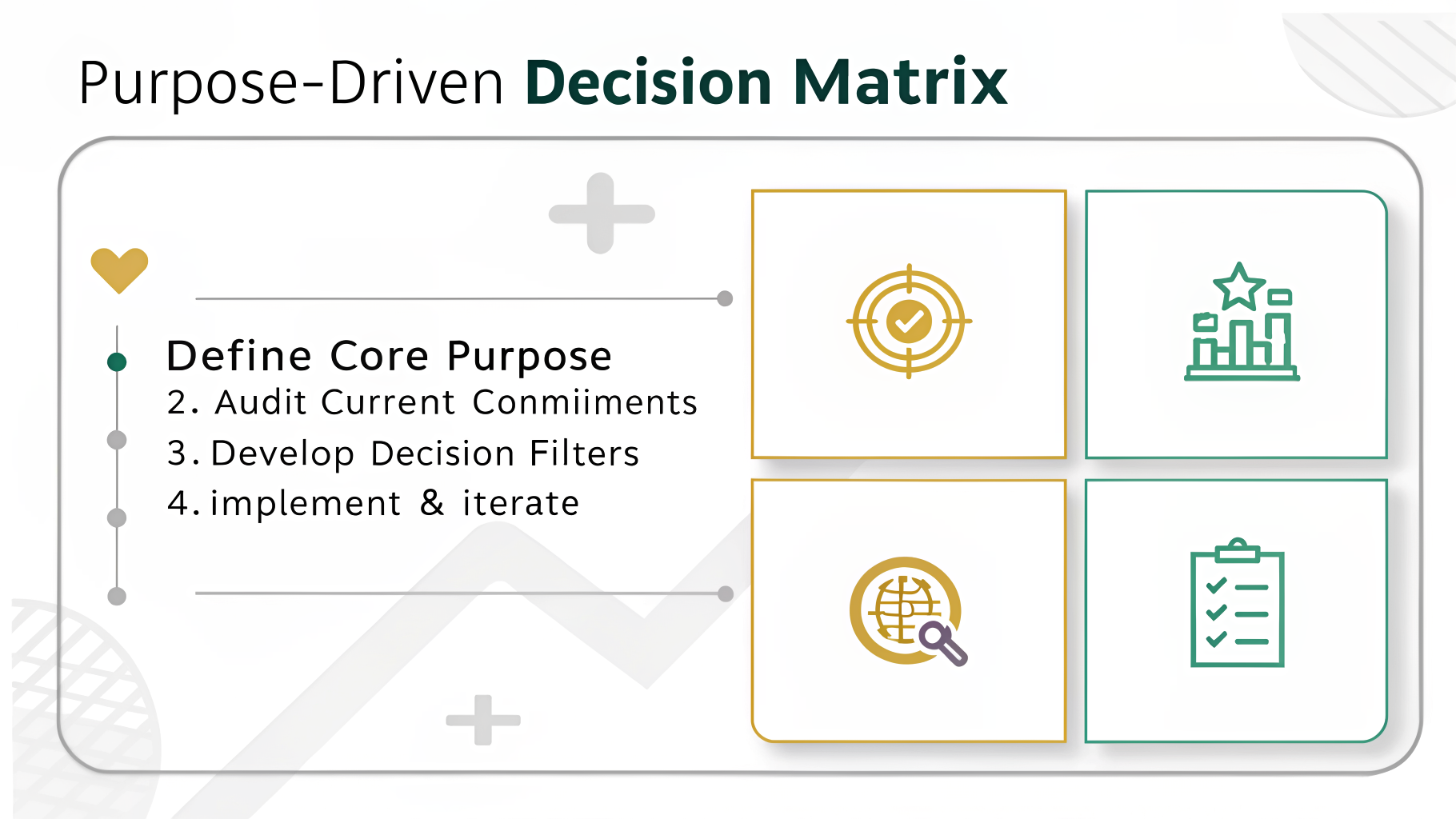
Auditing Commitments & Building Your Purpose-Driven Decision Filter

Even with a clear purpose, high-achievers often struggle to translate that clarity into daily action. This is where auditing your current commitments and building a personalized decision filter becomes essential for Reclaiming Your Purpose: How Strategic Decisions Can Prevent Burnout and Decision Fatigue for High-Achievers.
Audit Current Commitments
List every significant time, energy, and financial commitment. This includes professional projects, volunteer work, social obligations, and even personal habits. For a senior manager in Calgary, this might mean mapping out 60+ hours of work, weekly board meetings, and weekend family events against their core value of "impactful innovation." Identify which activities drain your energy without contributing to your defined purpose.
Identify Energy Drains & Misalignments
Compare each commitment from your audit against your core purpose and values. Many high-achievers find that some of their activities are misaligned, contributing to decision fatigue. A marketing director in Vancouver might realize that managing a legacy product, while profitable, no longer aligns with their purpose of "fostering sustainable community initiatives."
Develop Your Personal Decision Filter
Create 2-3 clear, actionable questions based on your purpose and values. For instance: "Does this opportunity directly advance [My Core Purpose]?" or "Does this commitment align with [My Top Value, e.g., 'Family Well-being'] without excessive personal cost?" This filter acts as a gatekeeper for new requests and a re-evaluation tool for existing ones.
Proactive Prevention: Integrating Strategic Decisions into Daily Life and Work
Many high-achievers find themselves reacting to burnout, rather than systematically avoiding it. The key to Reclaiming Your Purpose: How Strategic Decisions Can Prevent Burnout and Decision Fatigue for High-Achievers lies in embedding your Purpose-Driven Decision Matrix into daily actions. This means applying micro-decision filters: before saying "yes" to a new project or even scheduling a meeting, quickly filter it against your core values. For instance, a senior marketing director in Vancouver might ask, "Does this client pitch truly align with my value of 'sustainable innovation' or is it just another revenue stream?"
Regular 'purpose check-ins' are non-negotiable. Schedule a 15-minute review every Friday morning, perhaps while reviewing your week, to assess how recent choices measured up. This proactive habit helps you spot early warning signs of misalignment or creeping fatigue before they escalate. If you consistently feel drained after meetings about a specific initiative, that's a signal to re-evaluate its purpose alignment. Strategic planning and goal setting, when deeply aligned with personal values, may help build resilience against stress.
This isn't about rigid adherence, but agile adjustment. If your core values shift after a significant life event, like a promotion or starting a family, adapt your matrix. MySerenity users often find the journaling feature helpful for tracking these shifts, allowing them to refine their filters over time. The goal is to make purpose-aligned choices so habitual they become your default, systematically preventing decision fatigue before it ever takes root.
Sustaining Your Reclaimed Purpose: Long-Term Resilience and Fulfillment
Sustaining Your Reclaimed Purpose: Long-Term Resilience and Fulfillment
Even after building a robust Purpose-Driven Decision Matrix, high-achievers often encounter unique psychological hurdles when sustaining a new, purpose-aligned path. The fear of losing a competitive edge, or an identity crisis tied to past achievements, can make slowing down feel like a personal failure.Strategies for Sustained Purpose
- Communicate New Boundaries: Clearly articulate your redefined purpose and capacity to your team, clients, and family. A senior project manager in Vancouver might inform stakeholders of new "no-meeting Fridays" to prioritize strategic planning.
- Cultivate Self-Compassion: Recognize that "Reclaiming Your Purpose: How Strategic Decisions Can Prevent Burnout and Decision Fatigue for High-Achievers" is an iterative process. It's okay if a new boundary occasionally shifts or needs re-evaluation.
- Embrace a Growth Mindset: Your purpose isn't static. Regularly revisit and refine your decision matrix as your values and life circumstances evolve, perhaps during a quarterly personal retreat.
- Build a Support Network: Connect with other high-achievers who are also prioritizing purpose over relentless pursuit. Sharing strategies with a peer mentor can provide invaluable perspective.
Psychological Barriers to Overcome
- Fear of Failure/Loss of Status: The deeply ingrained drive to always succeed can make any perceived "slowdown" feel like a threat to identity. A CEO in Calgary might struggle with delegating tasks previously considered essential to their personal brand.
- Guilt and External Expectations: High-achievers often feel responsible for others' success or happiness, leading to guilt when saying "no." This can manifest as pressure from family or colleagues to maintain old patterns.
- Identity Crisis: If your self-worth was heavily tied to external achievements, shifting focus can trigger questions about "who you are" without constant striving.
Frequently Asked Questions
Can strategic decisions really prevent burnout and decision fatigue for high-achievers?
Yes, absolutely. Strategic decisions act as a crucial filter for high-achievers, preventing the accumulation of misaligned tasks that lead to burnout. By intentionally choosing projects and commitments that align with your core objectives, you conserve mental energy. For instance, a software architect in Calgary might decline a complex but non-essential feature request, opting to prioritize critical system stability, thus reducing decision fatigue and ensuring focus on high-impact work. This deliberate selectivity is key to sustainable productivity.
How do high-achievers identify their core purpose and values?
High-achievers identify their core purpose and values through structured self-reflection and analysis of past experiences. This often involves examining peak performance moments and periods of deep satisfaction, as well as significant challenges. For example, a person might reflect on projects where they felt most alive and impactful, revealing a core value like community contribution." Tools like values card sorts or journaling prompts can help surface these foundational beliefs, providing clarity for future choices and ensuring alignment.
What is a purpose-driven decision matrix and how does it help prevent overwhelm?
A purpose-driven decision matrix is a structured tool that evaluates opportunities or tasks against your core values and overarching purpose, not just urgency or impact. It helps prevent overwhelm by providing a clear filter: you score items based on their alignment with your "why." For instance, a marketing lead in Vancouver might assess new campaigns against criteria like "supports brand authenticity" and "drives sustainable growth," quickly identifying and deprioritizing tasks that don't resonate, thus reducing cognitive load and focusing energy effectively.
Why do high-achievers often experience a disconnect between their purpose and burnout?
High-achievers often experience this disconnect because their initial purpose, while strong, can become overshadowed by external demands, perceived obligations, or a lack of boundaries. They might say "yes" to too many opportunities, even those misaligned, believing they are still serving a broader goal. For example, an entrepreneur in Calgary passionate about innovation might get bogged down in investor relations and operational minutiae, losing sight of their creative drive. This dilution of focus depletes energy, leading to burnout despite a clear initial "why."
How can I integrate strategic decision-making into my daily work life to sustain fulfillment?
Integrate strategic decision-making by building small, consistent habits. Start each day by reviewing your top three priorities for alignment with your core purpose. Before accepting new tasks or meetings, ask yourself: "Does this directly serve my key objectives or values?" For example, a marketing specialist in Toronto might decline a low-impact networking event to focus on a high-value content strategy, ensuring their time directly supports their professional growth. Regularly reflecting on these choices helps you refine your filters and sustain fulfillment.
Frequently Asked Questions
Can strategic decisions really prevent burnout and decision fatigue for high-achievers?
How do high-achievers identify their core purpose and values?
What is a purpose-driven decision matrix and how does it help prevent overwhelm?
Why do high-achievers often experience a disconnect between their purpose and burnout?
How can I integrate strategic decision-making into my daily work life to sustain fulfillment?
Keep reading
All articles →
Stress or Burnout? A Self-Check for Driven Professionals
Exhaustion is not automatically burnout, and that distinction matters. This self-check walks you through the markers that separate ordinary work stress from a pattern you can no longer manage on your own.

How to Recognize Decision Fatigue Before It Derails Your Day
Your small choices may cost more energy than your big ones, and the research behind decision fatigue is messier than most articles admit. This guide shows how to spot the warning signs early and lighten your daily load with practical habits.

Burnout or Rustout? High-Achievers' Self-Diagnosis Guide
High-achievers often misinterpret professional unease as simple exhaustion, overlooking the critical distinction between burnout and rustout. This misdiagnosis leads to ineffective solutions, leaving them feeling even more stuck.