

Strategic Guided Journaling Prompts for Emotional Health: High-Achiever's Burnout Blueprint
Many high-achievers find generic advice on guided journaling for emotional health frustrating, feeling like they're just writing things down without real breakthroughs. This article reveals how strategic journaling can diagnose, process, and prevent emotional burnout.

Introduction: Beyond Generic Prompts – Your Strategic Path to Emotional Resilience
Many high-achievers find generic advice on guided journaling for emotional health deeply frustrating, often feeling like they're just "writing things down" without achieving real emotional breakthroughs or actionable insights. This article argues that effective journaling isn't about aimless catharsis; it's a strategic, analytical tool for diagnosing, processing, and preventing emotional burnout, much like a project manager uses data to identify bottlenecks.
You're not looking for a diary; you need a blueprint. This approach moves beyond superficial prompts that leave you feeling more overwhelmed than enlightened. Instead, we equip busy professionals with evidence-based mental wellness strategies that fit into demanding schedules, turning journaling into a proactive defence against the emotional exhaustion that many professionals experience.
By adopting a structured approach to guided journaling prompts for emotional health, you can cultivate deeper self-understanding and build sustainable well-being. This isn't about adding another task to your plate; it's about refining an existing one into a powerful mechanism for self-diagnosis and resilience, helping you transition from merely enduring stress to strategically managing it.
Why Traditional Journaling Often Fails High-Achievers (and What to Do Instead)
Many high-achievers find that traditional, unstructured journaling often deepens their frustration rather than alleviating it. The irony is stark: you carve out precious time for reflection, only to find generic prompts leave you feeling more scattered, or worse, convinced journaling just isn't for you.
Why Traditional Journaling Falls Short
- Lack of Specificity: General prompts like "How are you feeling today?" rarely tap into the complex, interconnected stressors high-achievers face, such as performance pressure or imposter syndrome.
- Superficial Engagement: Without a clear psychological framework, writing can feel like venting into a void, failing to offer the structured introspection needed for genuine emotional breakthroughs.
- Skepticism & Frustration: Previous attempts might have felt like "just writing," leading to a belief that journaling is ineffective for managing real-world stress or anxiety.
- No Clear Outcome: High-achievers are wired for results. Unstructured journaling often lacks a tangible goal, making it hard to commit to a practice that doesn't show clear benefits.
The Strategic Journaling Advantage
- Targeted Prompts: Strategic guided journaling prompts for emotional health are designed to address specific states like overwhelm or burnout, offering a clear purpose.
- Evidence-Based Foundation: This approach leverages research, like Pennebaker's work on expressive writing, to explain how externalizing thoughts creates psychological distance for objective analysis.
- Actionable Insights: Prompts are structured to move beyond mere reflection, guiding you toward identifying triggers, processing emotions, and formulating coping strategies.
- Measurable Progress: By focusing on specific emotional regulation skills, strategic journaling helps you track your journey from emotional chaos to resilience, appealing to an analytical mindset.
The Science of Strategic Journaling: How Guided Prompts Rewire Your Emotional Health
The Science of Strategic Journaling: How Guided Prompts Rewire Your Emotional Health
Many high-achievers approach emotional health with the same analytical rigour they apply to business problems, yet often feel frustrated by generic self-help advice. The true power of strategic guided journaling prompts for emotional health isn't just in writing things down; it's in literally reshaping your brain's response to stress. When you externalize thoughts and feelings through writing, you create psychological distance, allowing for more objective analysis and problem-solving, a mechanism well-documented by researchers like Pennebaker and Beall (1986).
This isn't just catharsis; it's a cognitive restructuring. Specific prompts direct your focus, moving you beyond surface-level complaints to uncover root causes and patterns. This structured reflection can enhance emotional regulation skills, crucial for managing the chronic anxiety often found in demanding professions. Expressive writing has been shown to reduce symptoms of depression and anxiety, improve working memory, and boost mood, according to Baikie & Wilhelm (2005) and Pennebaker (1997).
The measurable impact of consistent practice is clear. A 2018 study in the Journal of Medical Internet Research found that digital journaling interventions significantly reduced perceived stress and improved overall mental well-being.
Key Principles of Strategic Journaling for High-Achievers: Setting Your Practice for Success
Many high-achievers approach journaling with skepticism, having experienced generic prompts that felt more like busywork than a path to genuine insight. Strategic journaling, however, moves beyond surface-level reflection by establishing clear intentions for each session. You're not just writing; you're engaging in a focused psychological exercise designed to unpack specific emotional states, whether it's the gnawing stress of a looming deadline or the pervasive emotional exhaustion of burnout, which affects many professionals.
The core principle is understanding the “why” behind each prompt category. Others focus on emotional regulation, building resilience against chronic anxiety. This intentionality ensures deeper engagement and tangible results, rather than feeling like you're simply "just writing" without direction.
This structured approach, focusing on psychological benefits and consistent, brief engagement, transforms journaling from an optional activity into a powerful, evidence-based tool in your mental wellness arsenal. It's about building a sustainable practice that fits your demanding schedule, preparing you to explore specific diagnostic frameworks for your unique emotional state.
A Diagnostic Framework: Matching Prompts to Your Specific Emotional State (Stress, Anxiety, Overwhelm, Burnout)

Many high-achievers find themselves adrift in a sea of generic journaling prompts, unsure which ones actually address their specific emotional landscape. The real power of guided journaling prompts for emotional health lies not in random selection, but in strategic alignment with your current emotional state. Without a framework, you risk "just writing" without tangible breakthroughs, a common frustration for professionals seeking tangible results.
Consider this: burnout affects many professionals, with emotional exhaustion being a core component. To effectively combat this, you need to first identify where you are on the spectrum of stress, anxiety, or overwhelm. Before each journaling session, take 60 seconds to check in: rate your current stress level, anxiety, and energy on a simple 1-5 scale. This quick self-assessment in a mid-sized urban daycare, for instance, allows a director to pivot from general reflections to prompts specifically targeting their identified emotional fatigue, ensuring their limited journaling time is impactful.
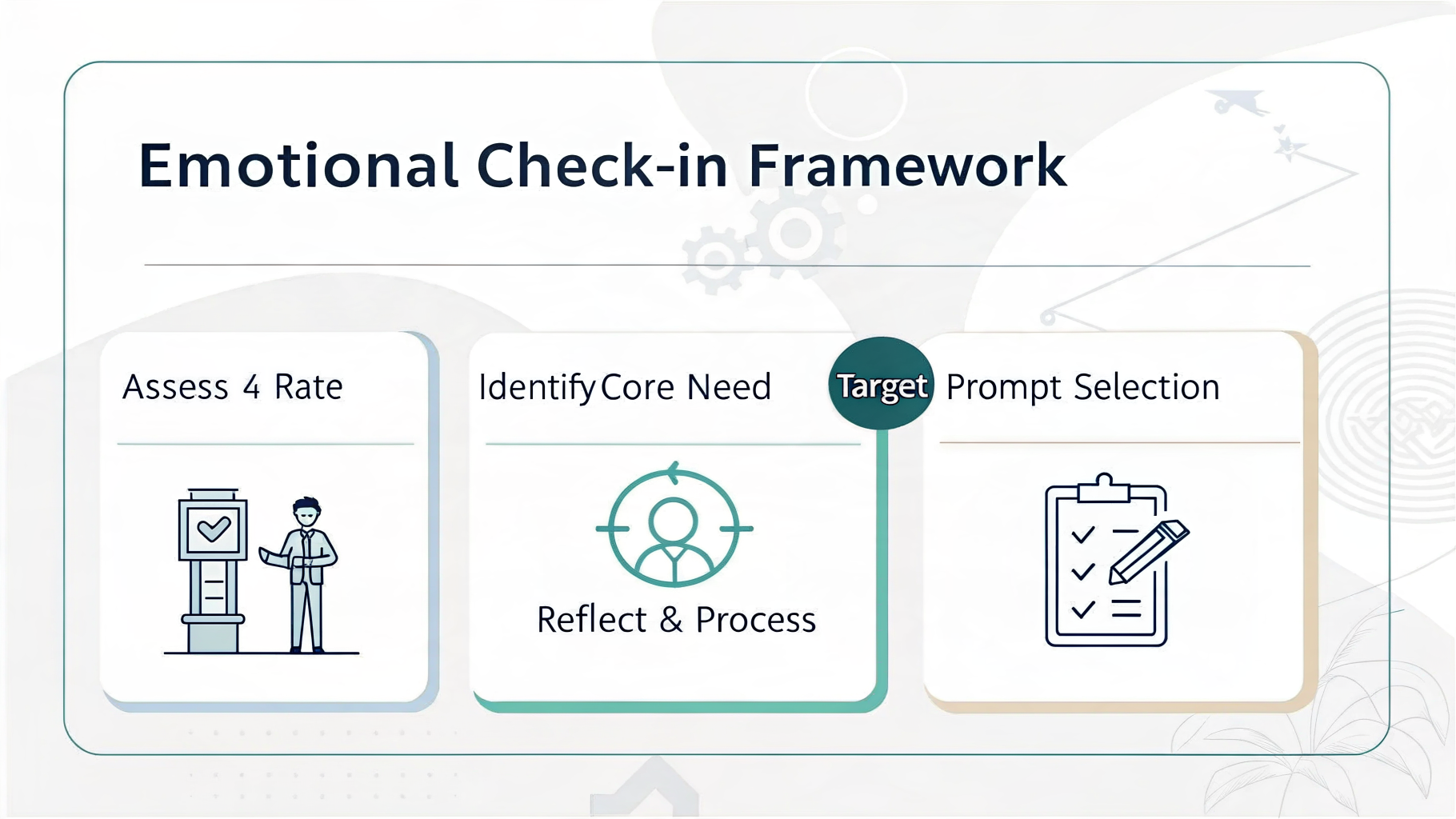
This diagnostic approach transforms journaling from a vague activity into a focused intervention. By understanding your emotional baseline, you can select prompts that truly resonate, moving beyond surface-level observations to address the root causes of your emotional distress, whether it's the pressure of a looming deadline or chronic work-life imbalance.
Guided Prompts for Unpacking Stress & Overwhelm: From Triggers to Release
Often, the first step to truly managing stress isn't about eliminating it, but about understanding its precise contours and hidden triggers. For high-achievers, this means moving beyond a generalized sense of "too much to do" and pinpointing the specific emotional and situational catalysts that lead to overwhelm.
Guided Prompts for Unpacking Stress & Overwhelm
Describe a recent situation that caused significant stress. What specific thoughts and physical sensations did you experience? What core need felt unmet in that moment?
How does this stress manifest in your daily work or relationships? For instance, does it lead to snapping at a colleague, or neglecting a personal commitment like a family dinner?
Looking back, when have you felt this particular type of stress before? Are there recurring patterns or themes, perhaps linked to perfectionism or fear of failure?
If this stress had a voice, what would it be trying to tell you? What emotion sits underneath the feeling of overwhelm—is it anxiety, frustration, or something else?
What is one small, concrete action you can take today to address the unmet need identified in the first prompt? How might reframing this challenge as an opportunity for growth change your perspective?
Emotional Regulation Journaling Exercises for Cultivating Resilience & Self-Compassion
Many high-achievers find themselves adept at managing external pressures but struggle with internal emotional storms, often leading to burnout. Cultivating resilience and self-compassion through targeted emotional regulation journaling exercises moves you beyond simply reacting to stress, helping you build a robust internal framework for long-term well-being.
Emotional Regulation Prompts for Resilience
Identify three emotions you felt most intensely yesterday. For each, describe its physical sensation, its trigger, and one healthier way you could have responded. This builds awareness, a first step in emotional regulation, as theorized by researchers like James Gross (1998).
Write a letter to your future self, say, six months from now. Acknowledge your current struggles, but also outline the resilient qualities you are cultivating and the self-compassion you commit to offering yourself. What advice would your future, wiser self give you today about handling pressure?
Recall a recent situation where you felt inadequate or failed to meet a goal. Write about it from the perspective of a kind, supportive friend. What gentle observations or encouraging words would they offer? This directly counters the harsh self-criticism common among high-achievers.
List three coping mechanisms you currently use when stressed (e.g., working longer hours, scrolling social media). For each, assess its short-term and long-term impact. Then, brainstorm one healthier alternative you could integrate, like a 10-minute walk or a brief meditation using an app like MySerenity.
Beyond the Page: How to Translate Journaling Insights into Actionable Strategies

Beyond the Page: Translating Insights into Action
You've poured your thoughts onto the page using guided journaling prompts for emotional health, gaining clarity on your stress triggers or anxiety patterns. The real challenge, for many high-achievers in Toronto's Bay Street firms or Vancouver's tech sector, is moving past reflection to concrete change. It's not enough to simply identify the problem; the objective is to build a feedback loop from insight to tangible action, preventing future burnout.Identify Your Core Insight
Review your recent journaling entries. What's the single most significant discovery or recurring theme? Perhaps you've realized that back-to-back virtual meetings consistently trigger your overwhelm. A 2018 study in the Journal of Medical Internet Research highlighted how digital journaling can reduce perceived stress, often by clarifying these patterns.
Brainstorm 1-3 Specific Actions
Based on your insight, what small, measurable steps can you take? Instead of "manage stress better," try "block 15 minutes between every meeting" or "decline one non-essential meeting per week." These actions should be within your control and clearly defined.
Predict the Impact
Envision the positive effect of these actions. If you block time between meetings, how will your energy shift? I will feel less rushed and more focused for the next task.
Building a Sustainable Journaling Practice for Busy Professionals (Time-Saving Tips)
Fitting consistent self-care into a demanding schedule often feels impossible, yet even high-achievers can build a powerful journaling practice without sacrificing precious time. The key is strategic integration, not adding another overwhelming task to your plate.
Quick Reference: Integrating Journaling into Busy Days
Dedicate just 5-10 minutes. A senior executive in Calgary might use their commute or a brief lull between meetings for one targeted prompt.
Schedule a non-negotiable 7-minute slot, perhaps during your morning coffee or before bed. This is roughly the time for a quick break, not a major commitment.
Leverage apps like MySerenity or Day One for convenience. A 2018 study in the Journal of Medical Internet Research showed digital journaling significantly reduced perceived stress, highlighting their effectiveness.
Choose one specific guided journaling prompt for emotional health. Don't try to solve everything at once; pinpoint one feeling or challenge.
Pair journaling with an existing habit. For instance, journal while your tea steeps or immediately after your morning workout.
The goal isn't to write a novel, but to engage in consistent, brief reflection. These small, deliberate actions accumulate, transforming an intimidating task into a manageable habit that supports your emotional well-being and prevents burnout.
Strategic Journaling Approaches: A Quick Comparison for High-Achievers
You might feel overwhelmed by the sheer number of journaling methods available, unsure which one truly supports your emotional health and busy schedule. This quick comparison helps you pinpoint the strategic journaling approach that aligns best with your current needs, moving beyond generic guided journaling prompts for emotional health to targeted, effective practices.| Aspect | Expressive Writing | Cognitive Restructuring Journaling | Gratitude Journaling |
|---|---|---|---|
| Primary Goal | Process intense emotions, reduce stress (Baikie & Wilhelm, 2005). | Challenge negative thought patterns, reframe perspectives. | Shift focus to positive aspects, boost mood. |
| Best For | Unpacking trauma, chronic stress, emotional exhaustion. | Anxiety, persistent negative self-talk, perfectionism. | Low mood, general overwhelm, fostering resilience. |
| Time Commitment (Daily) | 15-20 minutes, 3-4 times/week (Pennebaker, 1997). | 10-15 minutes, as needed or daily. | 5 minutes, daily. |
| Example Prompt Focus | "Describe your deepest feelings about [situation] without judgment." | "What evidence supports/refutes this thought? What's an alternative perspective?" | "List 3 specific things you're genuinely thankful for today and why." |
When to Seek Professional Support (and How Journaling Can Help You Prepare)
Even the most strategic journaling practice has limits; sometimes, the support of a mental health professional is essential. You might need to seek external help if symptoms like persistent low mood, overwhelming anxiety, or significant sleep disturbances last for more than a few weeks, or if they start to impair your daily functioning at work or in relationships. For instance, if you're consistently missing deadlines at your Toronto-based tech firm or struggling to connect with your family in the evenings due to emotional exhaustion, it's a clear signal.
Your existing practice with guided journaling prompts for emotional health can actually make professional support more effective. By regularly documenting your thoughts and feelings, you're building a valuable "data set" for your therapist. This record can articulate specific triggers, emotional patterns, and the intensity of your experiences, allowing initial therapy sessions to become immediately productive. Instead of spending early appointments trying to recall vague feelings, you can present concrete examples, like "On Tuesday, after that project review, I felt a familiar tightness in my chest, similar to what I wrote about last month after the Q3 budget meeting."
Using your journal to track these insights helps you communicate your needs clearly and concisely, fostering a more collaborative and efficient therapeutic process. This structured approach ensures you're not just writing, but actively preparing for deeper healing, which we'll explore further in how journaling can translate into actionable strategies.
Verdict: Your Blueprint for Strategic Guided Journaling Prompts for Emotional Health
Strategic journaling is far more than a casual habit; it is a precise, analytical instrument designed for your high-achiever mindset. You’re not just writing; you’re engaging in a proactive diagnostic process, using structured reflection to pinpoint emotional triggers and build resilience. This approach directly counters the common pitfall of generic prompts that leave you feeling unfulfilled, instead offering a clear pathway to genuine emotional breakthroughs.
The power of evidence-based guided journaling prompts for emotional health lies in their ability to foster deep self-awareness. For instance, studies like the 2018 research in the Journal of Medical Internet Research highlight how digital journaling significantly reduces perceived stress and improves overall mental well-being. This isn't about simply venting; it's about externalizing thoughts and feelings to gain psychological distance, allowing for more objective analysis and problem-solving, a technique championed by researchers like Pennebaker. Even short, targeted bursts of journaling, five to ten minutes daily, can create meaningful shifts, helping you manage anxiety and ease the emotional exhaustion that many professionals experience.
Embracing this structured, actionable blueprint helps you take control of your emotional well-being. It’s about applying the same strategic thinking you use in your professional life to your inner world, transforming journaling into a powerful tool for sustained success and personal peace.
Frequently Asked Questions
How can guided journaling prompts improve emotional health for high-achievers?
High-achievers, like a senior marketing director in Vancouver, often push past emotional signals, viewing them as distractions from goals. Guided prompts shift focus from "what's next?" to "how am I feeling right now?", fostering self-compassion. This structured reflection helps them identify patterns of burnout or imposter syndrome before they escalate, improving decision-making and preventing the emotional depletion that often accompanies relentless pursuit of success. It's about sustainable performance, not just output.
Why is strategic journaling more effective for managing stress and overwhelm?
Strategic journaling moves beyond simple venting, encouraging structured reflection on specific stressors. For instance, a project manager overwhelmed by deadlines can use prompts to dissect the root causes of their stress, like "What specific task feels most daunting, and why?" This approach helps identify cognitive distortions or unhelpful thought patterns. By systematically exploring triggers and responses, individuals develop actionable coping strategies and gain clarity, transforming diffuse overwhelm into manageable challenges, much like a focused problem-solving session.
What are some guided journaling prompts for anxiety and emotional regulation?
Effective prompts for anxiety and emotional regulation encourage detailed observation and re-framing. Consider: "Describe your anxiety as a physical sensation. Where do you feel it, and what colour is it?" or "What's one small action you can take today to honour a feeling you're experiencing?" These prompts help externalize feelings, reducing their intensity. Another is "Identify a recent situation where you felt overwhelmed. What was the trigger, and what alternative response could you practice next time?" This builds self-awareness and proactive coping mechanisms.
Can journaling really help rewire my brain for better emotional resilience?
Yes, consistent journaling can contribute to neuroplasticity, the brain's ability to form new neural connections. When you regularly reflect on emotions and reframe negative thoughts, you strengthen pathways in the prefrontal cortex, the area responsible for executive functions like emotional regulation and decision-making. This practice helps shift from reactive emotional responses to more thoughtful, resilient ones. For example, consistently identifying gratitude can literally make your brain more attuned to positive experiences, fostering a more optimistic outlook over time.
Is there a diagnostic framework to choose the right journaling prompts for my emotional state?
While not a clinical diagnostic framework, a self-assessment approach guides prompt selection. Start by identifying your primary emotional need: Do you seek clarity on a specific stressor, release from pent-up frustration, or a shift towards gratitude? For instance, if feeling overwhelmed, prompts focusing on problem-solving or task breakdown are beneficial. If experiencing low mood, gratitude or future-oriented prompts might help. Tools like MySerenity often categorize prompts by emotional state (e.g., "Anxiety Relief," "Self-Compassion") to help you choose based on your current feelings and desired emotional shift.
Frequently Asked Questions
How can guided journaling prompts improve emotional health for high-achievers?
Why is strategic journaling more effective for managing stress and overwhelm?
What are some guided journaling prompts for anxiety and emotional regulation?
Can journaling really help rewire my brain for better emotional resilience?
Is there a diagnostic framework to choose the right journaling prompts for my emotional state?
Keep reading
All articles →
Stress or Burnout? A Self-Check for Driven Professionals
Exhaustion is not automatically burnout, and that distinction matters. This self-check walks you through the markers that separate ordinary work stress from a pattern you can no longer manage on your own.

How to Recognize Decision Fatigue Before It Derails Your Day
Your small choices may cost more energy than your big ones, and the research behind decision fatigue is messier than most articles admit. This guide shows how to spot the warning signs early and lighten your daily load with practical habits.

Burnout or Rustout? High-Achievers' Self-Diagnosis Guide
High-achievers often misinterpret professional unease as simple exhaustion, overlooking the critical distinction between burnout and rustout. This misdiagnosis leads to ineffective solutions, leaving them feeling even more stuck.