

Lessons from the Top: Strategic Inactivity for AI Execs to Prevent Burnout
Many AI executives prevent burnout by strategically embracing inactivity, a counter-intuitive approach involving intentional periods of non-work and deep rest. This isn't a luxury; it's a deliberate performance enhancer, critical for innovation and sustained output.

The Relentless Pace: Why AI Leaders Need a New Approach to Wellness
Many AI executives and high-achievers prevent burnout not by working harder, but by strategically embracing inactivity – a counter-intuitive approach that involves intentional periods of non-work, deep rest, and even 'mind-wandering.' This isn't a luxury; it's a deliberate performance enhancer, directly challenging the tech industry's "always-on" culture and the fear of appearing less committed. In fact, top performers view these breaks as critical for innovation and sustained output, rather than a sign of weakness.
The relentless pace of AI development and its high-stakes environment often leaves leaders feeling overwhelmed, struggling to find practical coping mechanisms that don't compromise performance. Many professionals report experiencing burnout at their current job, and tech workers are often among the most stressed professionals. Traditional "self-care" advice often misses the mark for those juggling multi-million dollar projects and rapid technological shifts.
This article shares specific, actionable strategies from Lessons from the Top: How Leading AI Executives and High-Achievers Prevent Burnout and Maintain Mental Wellness in High-Pressure Industries. You'll discover how leaders at companies like Google DeepMind and OpenAI integrate strategic inactivity into their demanding schedules, fostering mental resilience and sustained excellence without fearing vulnerability. We’ll move beyond generic advice to give you a blueprint for thriving in the AI frontier.
How We Uncovered the 'Strategic Inactivity' Blueprint
Many discussions around executive burnout miss a crucial point: the most effective strategies aren't about adding more to an already packed schedule, but about strategically subtracting. We sought to understand this counter-intuitive truth when exploring Lessons from the Top: How Leading AI Executives and High-Achievers Prevent Burnout and Maintain Mental Wellness in High-Pressure Industries, focusing on the unconventional methods high-performers use to sustain their demanding pace.
Our Research Approach
Prioritized strategies that fit easily into demanding schedules, such as a 15-minute "thought-block" between meetings, rather than requiring significant time commitments or lifestyle overhauls.
Filtered out vague "self-care" tips. Instead, we looked for specific, actionable tactics, like deliberately scheduling "mind-wandering" time instead of back-to-back calls, which directly address decision fatigue in complex AI projects.
Identified methods that tackled the unique cognitive and emotional demands of the AI sector – for instance, managing the ethical dilemmas of large language models, a stressor often overlooked by general wellness advice.
Understanding the Unique Pressures on AI Executives and High-Achievers
The Unique Pressures on AI Executives and High-Achievers
Many discussions around burnout miss a critical point: the stress faced by AI executives and high-achievers isn't just "more" stress; it's qualitatively different. These leaders contend with constant innovation cycles, ethical quandaries — like bias in large language models — and rapid technological shifts that demand continuous learning. This relentless pace can contribute to high stress for many tech workers.
Beyond the external pressures, internal struggles like imposter syndrome are rampant. A senior AI director in Vancouver, for instance, might feel an intense pressure to always have the "right" answer for complex model deployments, even when the technology itself is still evolving. This perfectionism, combined with the sheer cognitive load of managing intricate AI projects, leads to significant decision fatigue. Generic stress management for AI professionals often overlooks these specific cognitive demands, focusing instead on broader wellness tips that feel out of touch for someone grappling with the societal implications of their next product launch.
Burnout isn't a personal failing, but a systemic issue amplified in high-pressure sectors like AI.
The Silent Signs: How Burnout Manifests in Top Performers
You might be experiencing burnout long before you feel a total collapse. For many high-achieving AI executives, the signs are subtle, often dismissed as merely “part of the job” – a dangerous miscalculation in an industry that demands peak cognitive function.
Normal High-Stress (Not Burnout)
- Temporary Fatigue: Feeling tired after a late night coding session for a product launch, but recovering with a good night's sleep.
- Increased Focus: Hyper-focusing on a complex machine learning model, driving intense but productive hours.
- Short-Term Irritability: Snapping at a colleague once due to project deadline pressure, followed by quick resolution.
- Motivated by Challenge: Feeling energized by the prospect of solving a novel AI problem, even under pressure.
- Clear End-Goal: Seeing a definitive end to the intense period, like completing a major client presentation.
Early Burnout Indicators
- Chronic Exhaustion: Persistent fatigue that isn't relieved by rest, impacting your ability to engage with new AI research.
- Cynicism & Detachment: A growing disinterest in your work, perhaps feeling like your efforts on a new generative AI tool are pointless.
- Reduced Efficacy: Struggling to complete tasks that were once easy, like debugging a Python script or leading a team meeting.
- Increased Irritability: Persistent short temper with your team in Montreal or during calls with venture capitalists.
- Masking Through Overwork: Pushing harder to compensate for declining performance, creating a vicious cycle.
Strategic Time & Energy Management: Beyond the Calendar

Strategic Time & Energy Management: Beyond the Calendar
The common advice to "manage your time" often misses the real challenge for AI executives: managing cognitive load. Top performers in AI recognize that mental energy is a finite resource, not just a matter of hours in a day. They employ 'decision budgeting,' consciously allocating mental bandwidth to high-impact choices like selecting a new machine learning model or navigating ethical AI deployment in a specific sector, rather than frittering it away on minor operational details. This protects against decision fatigue, a significant contributor to burnout. These leaders also ruthlessly prioritize 'deep work' blocks. For instance, a CTO at a Vancouver-based AI startup might schedule an uninterrupted three-hour session every Tuesday morning to architect a new neural network, blocking out emails and meetings. This shields critical focus from constant interruptions and the rapid technological shifts inherent in AI development, helping prevent AI executive burnout. They conduct personal 'energy audits,' understanding their peak performance times – often early mornings for complex problem-solving – and structure demanding tasks accordingly for optimal output and reduced strain.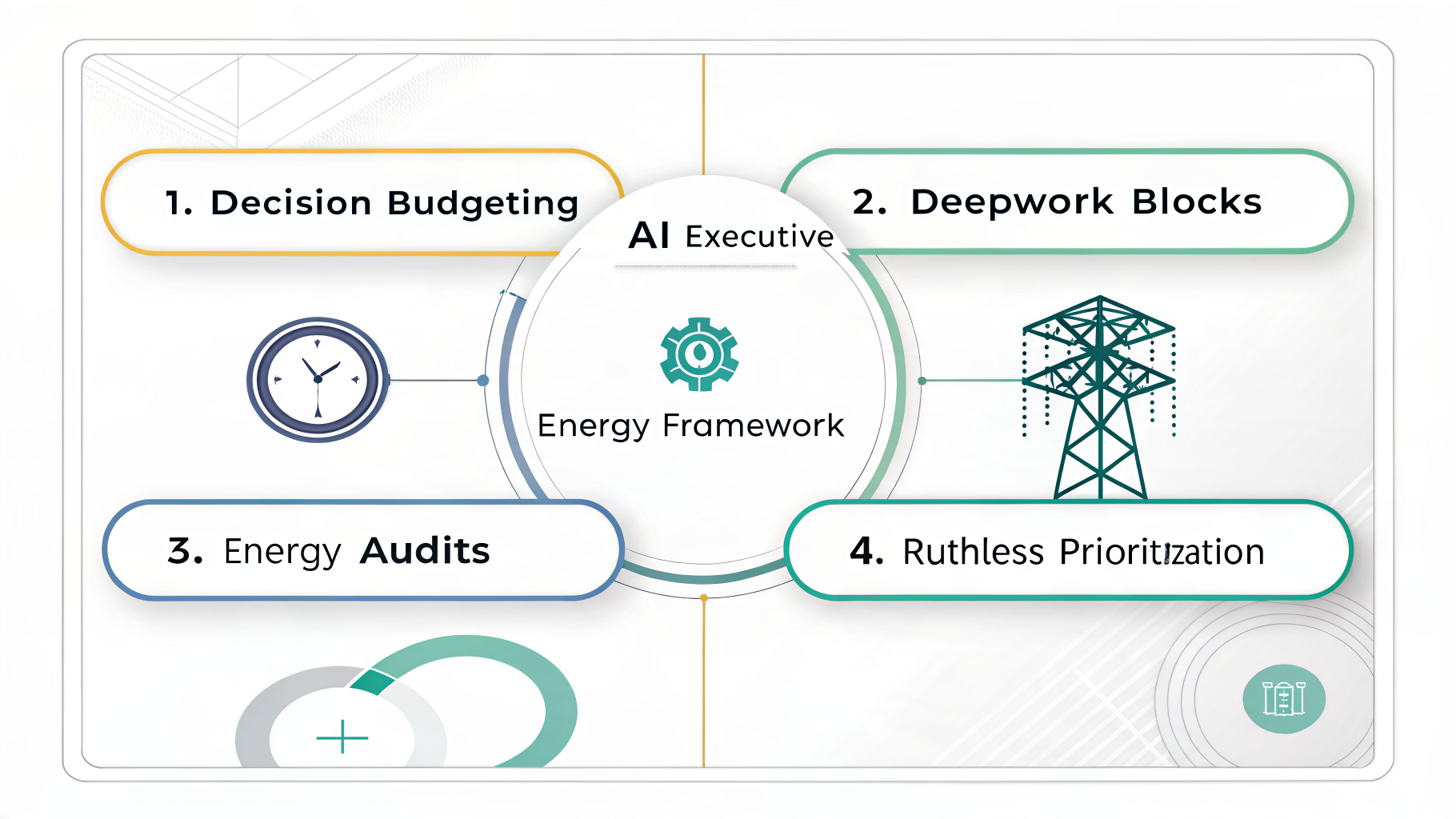
Cultivating Mental Resilience: Mindset Shifts from the Top
Cultivating Mental Resilience: Mindset Shifts from the Top
Many high-achievers in AI dismiss traditional "self-care" as too soft or generic, believing it doesn't apply to their intense reality. Yet, the most resilient AI leaders don't just endure pressure; they actively cultivate a specific mental toughness. This isn't about ignoring stress, but fundamentally altering how they perceive challenges and setbacks. For instance, a CTO at a Toronto-based AI startup leading a team of 30 engineers might reframe a failed model deployment not as a personal defeat, but as critical data points for the next iteration, fostering a growth mindset essential for rapid innovation cycles.
This reframing extends to internal battles. Imposter syndrome is rampant among high-performers, with Many tech workers report high stress levels., often fueled by perfectionism. Leading executives counter this by practicing cognitive reframing, acknowledging the complexity of AI development, and setting realistic expectations for themselves and their teams. They understand that perfection is often the enemy of progress in a field evolving daily.
Mindfulness and gratitude also serve as practical tools, not just pleasantries. A senior data scientist at a Vancouver-based fintech firm might use a 5-minute gratitude practice before a demanding sprint planning meeting to enhance emotional regulation and cognitive clarity. These are core components of the MySerenity approach to mental wellness, providing structured, evidence-based practices that move beyond superficial advice.
The Power of Strategic Disengagement: Deliberate Breaks, Hobbies, and 'Mind-Wandering'
Many AI executives, often feeling the immense pressure to constantly innovate, paradoxically discover that their most profound insights emerge not from relentless work, but from intentional periods of disconnection. This concept, which we call 'strategic inactivity,' reframes non-work time not as a luxury or a sign of weakness, but as a critical performance enhancer and a core component of sustainable high-achievement in high-pressure industries.
Schedule Deliberate Breaks
Top performers in AI don't just hope for breaks; they schedule them. This means blocking out non-negotiable time in their calendars for activities completely unrelated to work, whether it’s a mid-afternoon walk around the park near their Vancouver office or an hour dedicated to a hobby like woodworking. This isn't about fitting things in, but about prioritizing them as essential cognitive resets.
Embrace Engaging Hobbies
True detachment comes from activities that fully absorb your attention. A CTO at a Montreal-based AI startup, for instance, dedicates Saturday mornings to restoring vintage motorcycles. This kind of deep engagement with a non-work pursuit provides profound mental recovery, offering a different kind of cognitive challenge that shifts focus away from complex algorithms and strategic dilemmas.
Cultivate Mind-Wandering
'Diffuse thinking' or 'mind-wandering' is often overlooked, yet it's a powerful tool for creative problem-solving.
Leveraging Support Systems: Mentors, Coaches, and Professional Help

Leveraging Strategic Support Systems
Many AI leaders don't just endure pressure; they proactively build a robust network of support as a strategic asset. This isn't about admitting weakness, but about investing in sustained performance, much like a Formula 1 team invests in top-tier engineers. For instance, a senior director at Google DeepMind might lean on a mentor for navigating ethical AI deployment, drawing on their experience to gain perspective on dilemmas that lack clear precedents. This external guidance is crucial for mental wellness tips for high-pressure tech jobs, especially when facing the rapid shifts inherent in AI development.
Executive coaches offer another layer of strategic support, acting as accountability partners and sounding boards for high-stakes decisions. They help leaders at companies like OpenAI refine communication strategies or manage the pervasive imposter syndrome that often affects high-achievers in tech. Furthermore, while burnout is common among professionals, top AI executives are reframing professional mental health support not as a last resort, but as preventative maintenance. Engaging with a therapist or counsellor, for example, helps process decision fatigue from complex AI projects, ensuring cognitive load doesn't spill into full-blown exhaustion. These strategic alliances are fundamental to the "Lessons from the Top: How Leading AI Executives and High-Achievers Prevent Burnout and Maintain Mental Wellness in High-Pressure Industries," allowing them to maintain peak function without succumbing to the relentless pace.
Integrating Wellness into a High-Performance Culture: Leading by Example
Integrating Wellness into a High-Performance Culture: Leading by Example
Many top AI leaders recognize that personal well-being isn't a private matter; it's a foundational element of organizational success. They understand that for teams to truly innovate and avoid the pitfalls of burnout, especially in a field as demanding as AI, leaders must actively champion mental health initiatives. This means moving beyond generic "wellness programs" to deeply embed psychological safety into the company's DNA, reducing the cultural stigma often found in hyper-competitive tech environments.
Leaders at companies like Google DeepMind and OpenAI don't just manage their own stress; they implement policies that foster a supportive environment. Examples include "no-meeting Fridays" to protect deep work time, flexible working hours that accommodate diverse needs, and explicit encouragement for employees to take meaningful breaks. This isn't altruism; it's smart business. Poor mental health costs the global economy significant amounts in lost productivity each year, making wellness a core business imperative.
For AI executives asking themselves 'how do successful AI leaders avoid burnout', the answer often lies in creating a culture where open communication about challenges is not just permitted, but encouraged. Psychological safety is paramount here, allowing teams to openly discuss project roadblocks, ethical dilemmas, and personal stress without fear of reprisal. This approach directly contributes to the insights shared in Lessons from the Top: How Leading AI Executives and High-Achievers Prevent Burnout and Maintain Mental Wellness in High-Pressure Industries, demonstrating that true leadership involves cultivating an environment where both individuals and the organization can thrive.
Comparing the AI Leader's Burnout Prevention Toolkit
Understanding the varied approaches to mental wellness reveals that top AI executives don't rely on a single solution, but rather a robust toolkit. Many professionals under heavy pressure adopt layered strategies, moving beyond generic "self-care" to implement targeted interventions against the unique stressors of their field.
| Strategy | Primary Focus | Key Action | Benefit for AI Leaders | Difficulty |
|---|---|---|---|---|
| Strategic Time Management | Cognitive Load, Decision Fatigue | "Decision Budgeting" for key projects | Enhanced focus on high-impact AI initiatives | Medium |
| Strategic Disengagement | Mental Recovery, Creative Block | Scheduled "mind-wandering" breaks | Breaks through complex AI problem-solving | Low |
| Mental Resilience Training | Emotional Regulation, Imposter Syndrome | Regular sessions with an executive coach | Reduced self-doubt in rapidly changing AI landscape | High |
| Proactive Support Systems | Isolation, Pressure Management | Mentorship from an AI industry veteran | Gains perspective on ethical AI dilemmas | Medium |
These strategies, drawn from Lessons from the Top: How Leading AI Executives and High-Achievers Prevent Burnout and Maintain Mental Wellness in High-Pressure Industries, demonstrate that effective burnout prevention for high-achievers is about intentional, specific practices rather than accidental downtime. Integrating these diverse tactics allows for comprehensive protection against the relentless pace of AI innovation.
Actionable Frameworks: Building Your Personalized AI Executive Burnout Prevention Plan
Feeling the constant pressure of preventing burnout in demanding AI roles often makes personalized wellness plans seem like another impossible task. Yet, top AI executives don't just hope for balance; they build it strategically, moving past generic advice to create a proactive defense against the unique stressors of AI leadership.
Conduct a Burnout Audit
Identify your personal triggers and early warning signs. Does late-night coding on a new generative AI model in Toronto consistently lead to sleep disruption? Do back-to-back virtual meetings, common in global AI teams, leave you irritable? Recognize specific stressors before they escalate. Pinpointing your unique pattern is the first step away from becoming another statistic.
Integrate Strategic Inactivity
Start small: schedule one 15-minute "mind-wandering" walk each day, away from screens, or a 30-minute block for a non-work hobby like playing guitar. This isn't wasted time; it's a deliberate cognitive reset. An AI lead at Google DeepMind, for instance, might block out every Wednesday afternoon for uninterrupted creative thinking or personal development, treating it as non-negotiable.
Set Clear Boundaries
Communicate your availability clearly to your team and stakeholders.
Your Blueprint for Sustained Excellence: Embracing Strategic Inactivity
Your Blueprint for Sustained Excellence: Embracing Strategic Inactivity
The relentless pursuit of innovation in AI often masks a counterintuitive truth: true strength in AI leadership stems from intentional rest, not an endless grind. Many high-achievers in Canadian tech hubs like Waterloo and Vancouver mistakenly believe that constant activity signals dedication, yet many employees experience burnout at least sometimes. This isn't a badge of honour; it's a drain on creativity and decision-making for those leading multi-million dollar AI initiatives. Moving beyond generic "self-care" advice, the lessons from the top reveal a blueprint for integrating wellness directly into the executive workflow. Preventing burnout isn't a luxury for AI leaders; it's a critical component of long-term success, ethical leadership, and continuous innovation. For instance, a CTO at a Toronto-based AI startup might schedule "deep work blocks" alternating with mandated "mind-wandering" periods, recognizing that these breaks fuel problem-solving for complex machine learning challenges. It's time to challenge the traditional view of productivity and recognize that sustainable high-achievement in AI demands a personalized, proactive approach to mental wellness. Begin crafting your own strategic inactivity plan today, fostering a culture where sustained excellence is built on a foundation of deliberate rest and recovery.Frequently Asked Questions
What is strategic inactivity and how does it help AI leaders avoid burnout?
Strategic inactivity involves intentionally scheduling periods of non-work to allow the brain to reset. For AI leaders, this isn't just downtime; it's a proactive measure, like a CTO at an Ottawa-based AI startup dedicating 30 minutes daily to meditation or a "no-email zone" after 6 PM. This deliberate pause prevents cognitive overload, reduces decision fatigue, and surprisingly, often sparks new insights, helping them return to complex problem-solving with renewed clarity and energy, thereby staving off burnout.
How do top AI executives manage their time and energy to prevent burnout?
Top AI executives meticulously manage their time and energy by prioritizing high-impact tasks and rigorously setting boundaries. They often employ techniques like time blocking for "deep work" sessions, delegating operational tasks to their teams, and strictly adhering to meeting-free periods, much like a VP of AI at a Vancouver-based tech company might enforce "no-meeting Wednesdays." This disciplined approach safeguards their cognitive resources, ensures focus on strategic initiatives, and prevents the constant context-switching that rapidly depletes mental reserves, effectively preventing burnout.
Why is mental wellness so crucial for high-achievers in the AI industry?
Mental wellness is paramount for high-achievers in AI because the industry demands sustained cognitive intensity, complex problem-solving, and continuous innovation. An AI architect designing a new neural network for a fintech company in Montreal, for instance, requires peak mental clarity and resilience. Without robust mental health practices, the constant pressure to innovate and deliver can quickly lead to impaired judgment, reduced creativity, and ultimately, burnout. Prioritizing wellness ensures these leaders maintain the sharp focus and strategic thinking essential for groundbreaking AI development.
Can hobbies and deliberate breaks really improve performance for AI professionals?
Absolutely. Hobbies and deliberate breaks are not distractions but essential tools for enhancing performance among AI professionals. Engaging in activities like playing an instrument, hiking, or even a 15-minute mindful walk, as many AI engineers at Waterloo-based startups do, provides crucial mental distance from complex algorithms and data sets. This allows the subconscious mind to process information, often leading to "aha!" moments and creative breakthroughs. These breaks reduce stress, prevent mental fatigue, and ultimately improve focus and problem-solving capabilities upon returning to work.
Is there a specific framework for AI leaders to build a personalized burnout prevention plan?
While no single "one-size-fits-all" framework exists, AI leaders typically build personalized burnout prevention plans around key pillars: self-awareness, clear boundary setting, and proactive recovery strategies. This involves regularly assessing personal energy levels, defining strict work-life separation – like a CTO in Calgary scheduling "family-only" weekends – and integrating restorative practices such as exercise, mindfulness, or using wellness apps like MySerenity. The most effective plans are iterative, adapting to individual needs and the evolving demands of their high-pressure roles.
Frequently Asked Questions
What is strategic inactivity and how does it help AI leaders avoid burnout?
How do top AI executives manage their time and energy to prevent burnout?
Why is mental wellness so crucial for high-achievers in the AI industry?
Can hobbies and deliberate breaks really improve performance for AI professionals?
Is there a specific framework for AI leaders to build a personalized burnout prevention plan?
Keep reading
All articles →
Stress or Burnout? A Self-Check for Driven Professionals
Exhaustion is not automatically burnout, and that distinction matters. This self-check walks you through the markers that separate ordinary work stress from a pattern you can no longer manage on your own.

How to Recognize Decision Fatigue Before It Derails Your Day
Your small choices may cost more energy than your big ones, and the research behind decision fatigue is messier than most articles admit. This guide shows how to spot the warning signs early and lighten your daily load with practical habits.

Burnout or Rustout? High-Achievers' Self-Diagnosis Guide
High-achievers often misinterpret professional unease as simple exhaustion, overlooking the critical distinction between burnout and rustout. This misdiagnosis leads to ineffective solutions, leaving them feeling even more stuck.