

Decision Budget: 8 Doctor-Approved Strategies for High-Achievers
High-achievers often face decision fatigue, a 'silent drain' that causes paralysis over even trivial choices. This constant cognitive load depletes mental energy, making minor decisions feel overwhelming.
The Silent Drain: How Decision Fatigue Impacts High-Achievers
The Silent Drain: How Decision Fatigue Impacts High-Achievers
While high-achievers excel at complex problem-solving and strategic planning, a surprising irony is their frequent paralysis over trivial choices, like what to eat for lunch or which email to answer first. This isn't a lack of capability, but rather decision fatigue, a 'silent drain' that depletes mental energy, making even minor decisions feel overwhelming. Research suggests the average adult makes thousands of decisions daily, from the significant to the mundane, and this constant cognitive load disproportionately affects those in demanding roles who already face intense mental pressure.
Generic productivity advice, often focused on time management, frequently misses the mark for high-achievers because it fails to address this finite mental resource. Instead of offering another time-blocking technique, we propose a ‘Decision Budget’ framework: a strategic approach to allocating your mental energy like a financial resource. This framework acknowledges that your capacity for sound decision-making is not limitless, and by managing it proactively, you can avoid the impulsivity, procrastination, and impaired judgment that chronic decision fatigue can cause.
This article will outline practical, sustainable, and doctor-approved strategies to combat decision fatigue effectively. We'll move beyond superficial tips to offer evidence-based methods for high-achievers to prioritize, automate, and strategically delegate decisions, ensuring mental resilience and sustained peak performance in their demanding lives.
Our Criteria: What Makes a Strategy 'Doctor-Approved' and Effective?
High-achievers, often accustomed to vetting information rigorously, need to know that advice for managing mental energy isn't just surface-level. The strategies in this guide for combating decision fatigue are not mere productivity hacks; they are chosen based on specific, evidence-backed criteria, ensuring they address the unique demands of a high-achiever's life.
Our 'Doctor-Approved' Criteria
Each strategy is rooted in established neuroscience, cognitive psychology, or behavioural science, moving beyond anecdotal evidence. For example, techniques like 'decision diets' are supported by research on ego depletion, which confirms our finite capacity for executive function decisions.
Solutions must fit demanding schedules. A senior project manager in Vancouver, juggling multiple high-stakes projects, needs methods that integrate seamlessly, not add more complexity to their day.
We prioritize long-term habit formation over temporary fixes. The goal is to build lasting resilience against decision overload, not just offer a quick patch when you're already overwhelmed.
Strategies directly address the significant mental load faced by individuals making thousands of consequential decisions daily—from a corporate lawyer in Toronto to a small business owner in Calgary.
The advice helps distinguish decision fatigue from general stress or burnout, offering targeted interventions. Knowing the difference means you can apply the right solution, rather than misdiagnosing the problem.
This rigorous vetting ensures that the advice on <
Understanding Decision Fatigue: The 'Silent Drain' on High-Achievers
It’s easy for high-achievers to mistake mental exhaustion for a personal failing. You might push through long hours, excel in complex projects, yet feel inexplicably paralyzed by choosing dinner or responding to an email. This isn't a lack of willpower; it’s a physiological limit known as decision fatigue, a 'silent drain' that disproportionately affects those constantly making high-stakes choices.
Decision fatigue distinguishes itself from general stress or burnout. While burnout is a state of emotional, physical, and mental exhaustion caused by prolonged or excessive stress, decision fatigue specifically depletes your capacity for sound judgment. Research suggests the prefrontal cortex, vital for executive functions, becomes less effective with repeated demands. This aligns with the concept of 'ego depletion,' where our finite pool of mental energy for self-control and decision-making gradually runs dry. A senior kindergarten teacher in Halifax, for instance, might flawlessly manage a classroom of 25 children but then struggle to pick out groceries after school.
"It’s not that I'm less capable; it’s that my brain's battery is just dead by 3 PM after a day of constant micro-decisions." — elementary school principal, Calgary
The consequences are insidious. You might find yourself making impulsive choices, procrastinating on critical tasks, or avoiding decisions altogether, even when the stakes are high. This isn't laziness; it's a compromised mental state. Understanding this distinction is the first step in addressing The Silent Drain: Doctor-Approved Strategies for High-Achievers to Combat Decision Fatigue, allowing you to move past guilt and toward effective solutions.
The Science Behind the Struggle: What Happens in Your Brain
The Science Behind the Struggle: What Happens in Your Brain
You might feel frustrated when small choices suddenly feel monumental, a surprising disconnect for someone who routinely closes multi-million dollar deals. This isn't a lapse in your work ethic; it's a physiological reality. Your brain, specifically the prefrontal cortex, is a finite resource. This area handles executive functions like problem-solving, planning, and, crucially, decision-making. Each choice, from what to wear to how to respond to a critical email, draws on this limited cognitive pool.
Research indicates the average adult makes thousands of decisions daily. Every one of these demands a slice of your brain's energy, depleting essential neurotransmitters and glucose. Think of it like a battery draining throughout the day. By late afternoon, after navigating complex project approvals and team dynamics, even picking a dinner recipe can feel overwhelming. This phenomenon, often called 'ego depletion' in psychological studies, directly impacts judgment, making you more prone to impulsivity or procrastination on critical tasks.
Unaddressed, this constant mental taxation leads to chronic decision fatigue, a significant contributor to professional burnout, especially among high-achievers. Understanding this biological limit is the first step in implementing The Silent Drain: Doctor-Approved Strategies for High-Achievers to Combat Decision Fatigue. Recognizing that your brain has a finite "decision budget" allows you to manage it proactively.
Why High-Achievers Are Uniquely Vulnerable to Decision Overload

Why High-Achievers Are Uniquely Vulnerable to Decision Overload
Paradoxically, the very qualities that propel high-achievers to success—autonomy, accountability, and a drive for optimal outcomes—also make them acutely susceptible to decision fatigue. You might wonder why generic advice about simplifying choices often falls flat for you. It's because your decision landscape isn't just busy; it's densely packed with high-stakes, complex choices that carry significant personal and professional weight.
Consider a project lead in Vancouver overseeing a multi-million dollar software launch. Their daily choices range from critical architectural decisions to staffing allocations and client communications, each potentially impacting revenue or team morale. This isn't choosing between two brands of coffee; it's navigating thousands of impactful micro-decisions and macro-strategies, far exceeding the mental load of an average role. The prefrontal cortex, vital for these executive functions, becomes particularly vulnerable to exhaustion under such sustained pressure, as research on cognitive load consistently shows.
"High-achievers often internalize the pressure to always make the 'right' choice, viewing any misstep as a personal failure rather than a natural consequence of mental overload. This self-imposed burden is immense." — Executive Coach, Calgary
This constant demand for optimal judgment, coupled with societal pressures to maintain an image of effortless competence, contributes to chronic decision overload. It's why strategies like The Silent Drain: Doctor-Approved Strategies for High-Achievers to Combat Decision Fatigue are so essential: they recognize that your mental energy for decisions is a finite resource, requiring a strategic, almost financial, approach to budgeting.
Doctor-Approved Strategies: Building Your Personal Decision Budget
Building Your Personal Decision Budget
Many high-achievers find themselves paradoxically overwhelmed by minor choices, even as they conquer significant professional challenges. The core issue isn't a lack of capability, but a finite mental resource: your daily decision budget. This isn't a vague concept; research suggests the average adult makes thousands of decisions daily, from what to wear to strategic business moves. Each choice, no matter how small, draws from a limited well of cognitive energy, specifically from the prefrontal cortex responsible for executive functions. When this budget depletes, you experience decision fatigue, leading to impaired judgment, impulsivity, or paralysis.
To combat this, doctor-approved strategies suggest you consciously allocate your mental energy like a financial resource. First, learn to categorize decisions: identify 'high-value' choices that demand peak focus, such as a critical project proposal for a client in Vancouver, or complex team management in a Calgary-based tech firm. Then, pinpoint 'low-value' decisions ripe for automation or delegation, like meal planning or scheduling non-urgent meetings. This framework provides a clear, actionable guide for managing your finite mental energy, offering a structured approach beyond superficial tips for high-achievers combatting decision fatigue.
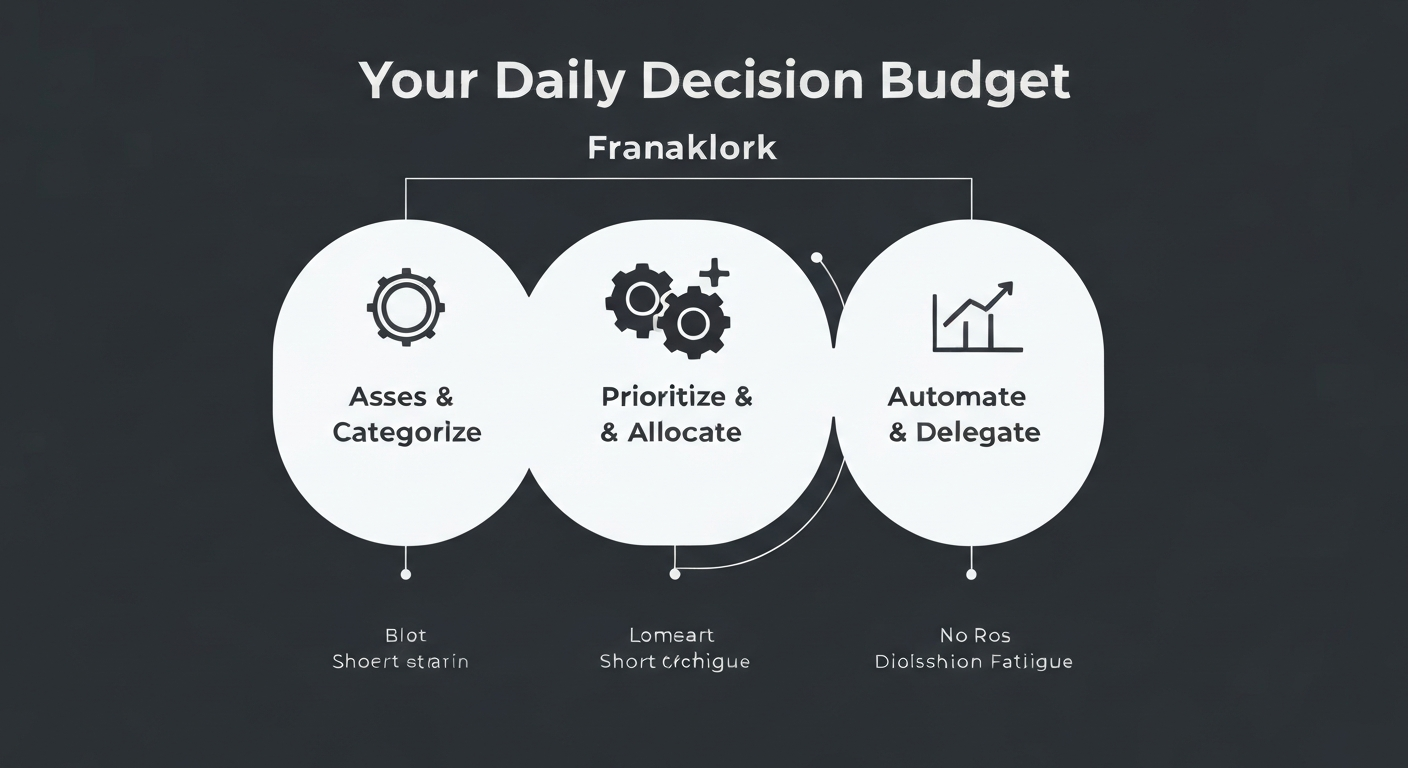
By actively managing your decision budget, you ensure that your most critical professional and personal choices receive the mental resources they deserve, reducing the silent drain of constant minor deliberations. This deliberate approach moves beyond simply reacting to mental exhaustion; it's about proactive, strategic energy
Proactive Prevention: Structuring Your Life to Conserve Mental Energy
Instead of waiting for mental exhaustion to strike, high-achievers can proactively build a robust "decision budget" by structuring their daily lives to conserve cognitive resources. This preventative approach, central to The Silent Drain: Doctor-Approved Strategies for High-Achievers to Combat Decision Fatigue, focuses on reducing the sheer volume of choices you face, freeing up your prefrontal cortex for truly critical decisions.
Implement 'Decision Diets'
Simplify routine choices to avoid "ego depletion." For instance, adopting a capsule wardrobe eliminates daily outfit dilemmas, saving mental energy. Similarly, a senior manager in Calgary might pre-plan all weekday lunches on Sunday, removing five daily decisions.
Automate Recurring Tasks
Set up automatic bill payments, recurring grocery orders, or email filters. Tools like Calendly can automate meeting scheduling, which a 2023 productivity report suggests can reclaim up to 30 minutes of decision-making time weekly for leaders.
Batch Similar Decisions
Group comparable tasks to reduce context-switching. A marketing director in Vancouver could dedicate one hour each Friday morning to review all team project updates and approve minor budget requests, rather than addressing them ad-hoc throughout the week.
Reactive Recovery: Bouncing Back When Decision Fatigue Hits Hard
Reactive Recovery: Bouncing Back When Decision Fatigue Hits Hard
You've hit the wall. The very thought of choosing a lunch spot feels monumental, and your brain fogs over simple emails. This isn't a sign of weakness; it's your prefrontal cortex, the brain's executive decision-maker, signalling depletion. Research confirms that our willpower and decision-making capacity are finite, making reactive recovery a vital skill for high-achievers. When decision fatigue has already set in, immediate, evidence-based techniques can help you regain focus and clarity. One effective strategy involves short, targeted mental breaks. A five-minute mindfulness exercise, focusing on your breath, can reset cognitive function more effectively than simply scrolling social media. Studies published in *Psychological Science* suggest even brief periods of meditation can improve attention and reduce mental wandering. Another powerful approach is to engage in 'no-decision' activities. A 20-minute walk in a local park, for example, allows your brain to shift gears, replenishing mental reserves without demanding further choices. This is part of **The Silent Drain: Doctor-Approved Strategies for High-Achievers to Combat Decision Fatigue**. Strategic delegation is also critical, even when you're ultimately accountable. For instance, if you're a project manager at a Calgary tech firm, you might empower a team lead to make daily micro-decisions on a specific feature, only requiring your input on major strategic shifts. This offloads numerous small mental burdens.Frequently Asked Questions
What is decision fatigue and how does it affect high achievers?
How can high achievers prevent decision fatigue using doctor-approved methods?
Why are high achievers more susceptible to decision overload?
Is creating a personal decision budget effective for managing mental energy?
Can professional guidance help manage severe decision fatigue?
Keep reading
All articles →
Doctor's Guide: Best AI Mental Wellness Apps for High-Achievers
For high-achievers battling burnout and decision fatigue, the real challenge isn't finding an app, but rather discerning which of the "best AI mental wellness apps" offer personalized, evidence-based support beyond simple meditation. These tools address specific stressors like perfectionism or performance anxiety.

High-Achiever's Blueprint: 7 Evidence-Based Anxiety Coping Strategies
Many high-achievers see anxiety as an unavoidable cost of ambition. However, clinically proven evidence based anxiety coping strategies offer significant symptom reduction, refining your internal operating system for success.

Strategic Mood Tracking: How to Effectively Track Your Mood for Burnout & Anxiety Management
Many find basic mood logging unhelpful for preventing burnout. This guide transforms mood tracking into a strategic process for proactive self-management.