

The Hidden Cost of Ambition: Are You Saving Up for Burnout?
The paradox of high achievement often builds a 'burnout savings account'—a silent accumulation of unaddressed stress. This article introduces the 'Ambition Audit' to help high-achievers redefine success and prevent an inevitable crash.

The Hidden Cost of Ambition: Are High-Achievers 'Saving Up for Burnout'?
The paradox of high achievement is that the very drive propelling individuals to success often simultaneously builds a 'burnout savings account'—a silent accumulation of unaddressed stress and unmet needs. While many believe sustained effort guarantees progress, a 2021 WHO/ILO study indicates working over 55 hours weekly significantly increases the risk of stroke, demonstrating that relentless accumulation often yields diminishing returns, not greater resilience. This article introduces the 'Ambition Audit,' a strategic framework to help high-achievers redefine success and prevent an inevitable crash.
For many driven professionals, particularly in demanding fields like tech in Vancouver or finance in Toronto, the relentless pursuit of goals isn't just a path to achievement; it's an unwitting accumulation of mental and physical debt. You might feel trapped by your own success, unable to slow down without a surge of guilt or the fear of losing ground to perceived competitors. This 'burnout savings account' metaphor highlights how small, unsustainable choices—like consistently skipping lunch, working late nights, or neglecting personal relationships—compound over time. Burnout rarely arrives as a sudden, cataclysmic event; instead, it's a gradual erosion, often mistaken for the normal demands of high performance, until the account balance becomes overwhelming.
The 'Ambition Audit' offers a proactive, strategic solution to this hidden cost of ambition. Instead of passively 'saving up' for an inevitable crash, this framework helps you critically assess your underlying drivers, redefine what success truly means beyond constant accumulation, and strategically divest from habits that deplete your well-being. It's about transforming that 'burnout savings account' into a 'resilience investment fund,' ensuring your ambitious journey is sustainable and genuinely fulfilling, not just a race to exhaustion.
Understanding the 'Burnout Savings Account': How High-Achievers Accumulate Stress
Understanding the 'Burnout Savings Account': How High-Achievers Accumulate Stress
Many high-achievers find themselves on an ironic trajectory: their relentless pursuit of success often leads them not to greater fulfillment, but to a growing deficit in their well-being. This is the insidious process of "saving up for burnout," where daily micro-stressors, unaddressed demands, and chronic overcommitment compound over time, much like financial savings. A senior marketing director in Vancouver, for instance, might routinely take on an extra client project, volunteer for a committee, and skip lunch to hit deadlines, believing each sacrifice is a deposit into their success account. Instead, they're accumulating stress that eventually demands a withdrawal.
There's a pervasive belief among high-achievers that constant effort and sacrifice are the only pathways to continued achievement. This mindset often overlooks the diminishing returns of overwork. Working more than 55 hours per week is linked to a higher risk of stroke and ischemic heart disease, while productivity often plateaus or declines. The psychological burden of these past sacrifices—the 'saving up'—now leads to an inevitable, overwhelming crash if not addressed. It's not just about feeling tired; it’s about a system pushed past its breaking point.
This cumulative effect is what makes the The Hidden Cost of Ambition: Why High-Achievers Are 'Saving Up for Burnout' and How to Break the Cycle so critical to understand. It's not a sudden event, but a slow build-up of unaddressed strain, creating a substantial debt that eventually comes due.
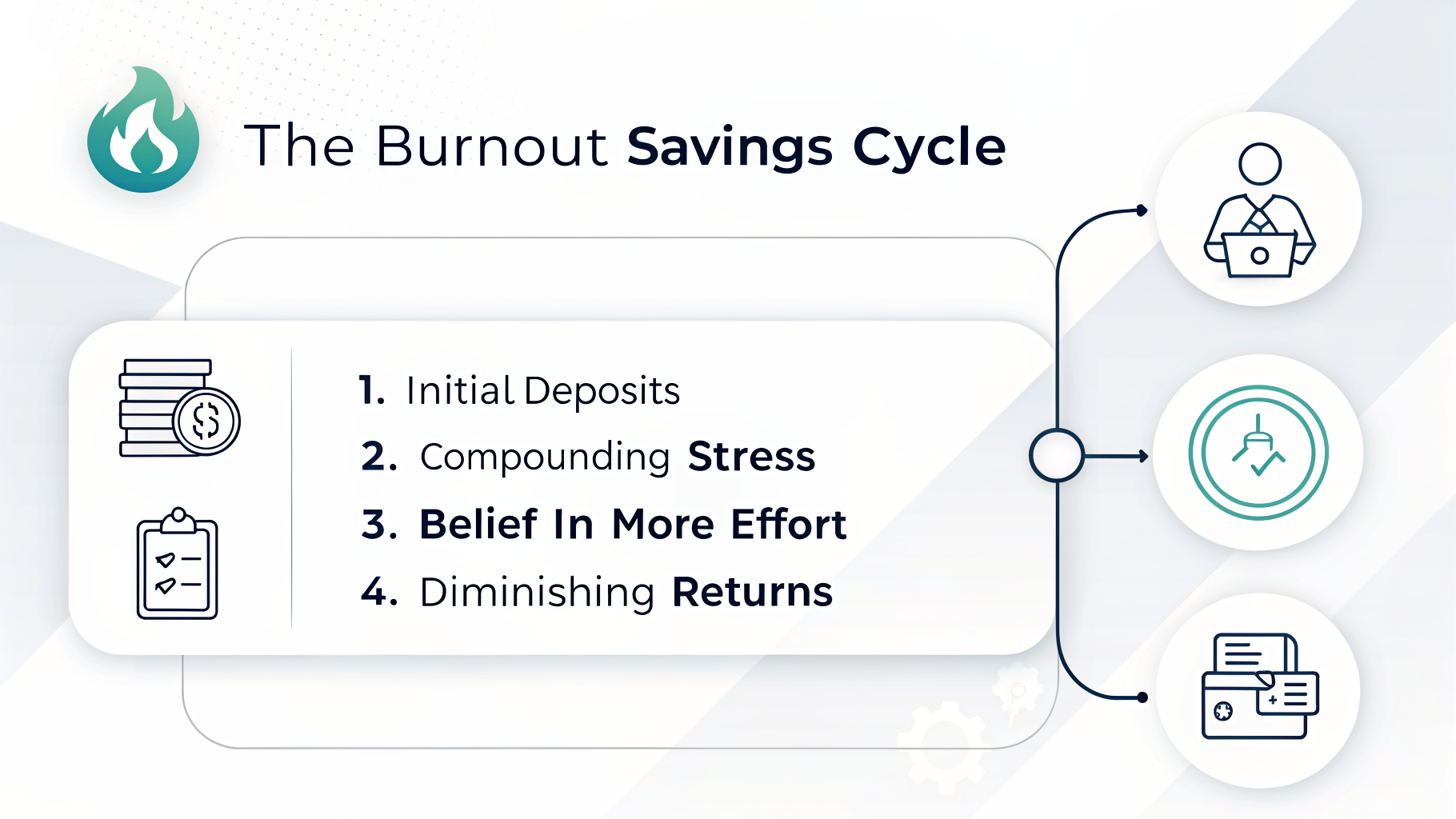
Recognizing this pattern is the first step toward transforming that 'burnout savings account' into a 'resilience investment fund.'
The Hidden Drivers: Why We Mistake Overwork for Worth and Identity
The Hidden Drivers: Why We Mistake Overwork for Worth and Identity
You might be a high-achiever who feels trapped by your own success, unable to slow down without a surge of guilt or the fear of losing ground. This feeling often stems from a deep-seated belief that your identity is inextricably linked to your professional achievements and external validation. For many, the very act of "doing" becomes "being," making it incredibly difficult to disengage without feeling a profound loss of self. A senior manager in financial services in Calgary, for example, might believe that their worth is directly tied to the number of client accounts they manage, regardless of the personal cost.
The fear of failure, or even just a perceived slowdown, can be a powerful motivator to keep pushing, even when exhaustion looms. This isn't just about career progression; it's often a primal fear of becoming "less than." When you've built a reputation for always delivering, saying 'no' to a new project or opportunity can feel like admitting weakness. In fact, many high-achievers struggle with setting clear boundaries, which can contribute to their overload and the phenomenon of 'saving up for burnout'.
Societal pressures and cultural narratives further normalize and even glorify this unsustainable ambition. Think of the "hustle culture" celebrated on social media, where sleepless nights and constant grind are badges of honour. This makes it challenging to question the status quo, creating a silent expectation that high performance demands endless sacrifice. You might internalize this, believing that any sign of fatigue means you're not trying hard enough, rather than recognizing it as a symptom of the hidden cost of ambition: why high-achievers are 'saving up for burnout'. Understanding these deep psychological roots is the first step toward redefining success and breaking this exhausting cycle.
Subtle Signs You're 'Saving Up' for Burnout (and Not Sustainable Success)

Subtle Signs You're 'Saving Up' for Burnout (and Not Sustainable Success)
Many high-achievers often miss the early whispers of burnout, mistaking them for the normal demands of their ambitious lives or simply "pushing through." This oversight is a critical component of The Hidden Cost of Ambition: Why High-Achievers Are 'Saving Up for Burnout' and How to Break the Cycle. It's not just about obvious exhaustion; the insidious signs often manifest as chronic cynicism about your work, a reduced sense of personal efficacy despite long hours, and a growing detachment from projects you once loved. You might find yourself snapping at colleagues or family members more often, a stark contrast to your usual composed self.
Consider a senior project manager in Vancouver who begins to dread Monday mornings, not because of a specific challenge, but due to a pervasive sense of futility. A person's usual attention to detail can wane, and small, uncharacteristic errors may start to appear. These aren't signs of laziness; they're cognitive symptoms like difficulty concentrating, memory issues, and decreased creativity – subtle but significant red flags that signal a deeper problem than just needing a weekend off.
This underscores how widespread burnout truly is, particularly among those driven by high ambition. The fact that many professionals experience burnout symptoms highlights its prevalence far beyond a niche issue. When many high-achievers struggle to say 'no,' it's likely that the cultural glorification of overwork contributes to this "burnout savings account."
Recognizing these early, often cognitive and emotional shifts is key. It's about distinguishing between a challenging period and a systemic drain on your resilience. Ignoring these signals means you're not just enduring; you're actively depositing into a burnout account that will eventually demand a massive withdrawal.
The True Cost: Beyond Exhaustion, The Toll on Your Life, Health, and Relationships
The True Cost: Beyond Exhaustion, The Toll on Your Life, Health, and Relationships
The relentless pursuit of achievement, often seen as a badge of honour, can quietly empty your reserves, leaving you with a significant deficit far beyond mere tiredness. This is the true hidden cost of ambition: why high-achievers are 'saving up for burnout' and how to break the cycle. It's not just about feeling tired; it’s about a profound erosion of your well-being, impacting physical health, mental clarity, and the very relationships meant to sustain you.
Unchecked ambition often leads to chronic stress, which the World Health Organization (WHO 2021) links directly to increased rates of anxiety, depression, insomnia, and serious physical health issues like heart disease and weakened immune systems. A senior software engineer in Vancouver, for instance, might initially thrive on 60-hour work weeks, but over time, consistent sleep deprivation and high cortisol levels can manifest as frequent colds and persistent headaches.
This internal strain inevitably spills over. Personal relationships suffer from irritability, emotional detachment, and a pervasive lack of presence outside of work. A marketing director in Calgary, constantly checking emails during family dinners, might find their partner feeling neglected and their children seeking attention elsewhere. Professionally, this 'burnout savings account' eventually diminishes productivity, increases errors, and leads to absenteeism, ultimately stalling the very career it aimed to advance. The CDC Foundation (2023) estimates the cost of burnout to businesses, through lost productivity and healthcare expenses, to be in the billions annually across North America.
To illustrate the tangible impacts of this relentless drive, consider how various aspects of life are compromised:
| Impact Area | Common Consequences for High-Achievers | Data/Observation |
|---|---|---|
| Mental Health | Increased anxiety, depression, chronic stress, difficulty concentrating | WHO (2021) links burnout to higher rates of anxiety and depression. |
| Physical Health | Insomnia, heart disease risk, weakened immunity, digestive issues | Working >55 hours/week increases stroke risk (WHO/ILO 2021). |
Redefining Ambition: Shifting from Constant Accumulation to Sustainable Growth and Impact
Redefining Ambition: From Accumulation to Sustainable Impact
Many high-achievers find themselves trapped by a definition of success that demands constant accumulation—more projects, more accolades, more hours. This relentless pursuit often means they are, in effect, 'saving up for burnout,' mistaking overwork for worth. To break this cycle, we need to critically reassess what ambition truly means.
The Shift: Sustainable Ambition
- Purpose-Driven Goals: Aligning professional pursuits with deep personal values, like a senior marketing director in Vancouver choosing projects that genuinely improve community well-being over purely profit-driven ones.
- Impact Over Volume: Prioritizing the quality and meaningfulness of contributions. A software developer at Shopify might focus on one impactful feature release per quarter rather than five minor updates.
- Well-being as a Metric: Including personal energy levels, mental clarity, and fulfilling relationships as non-negotiable indicators of success, not just an afterthought.
- Strategic Divestment: Consciously shedding commitments that drain energy without significant return, freeing up capacity for high-value work and personal life.
The Old Paradigm: Accumulative Ambition
- External Validation: Chasing promotions, salary increases, or public recognition as the primary drivers, often at the expense of internal satisfaction.
- Constant Growth Expectation: Believing every year must bring 'more' in terms of output or responsibility, regardless of personal capacity.
- Burnout as a Badge: Viewing long hours and exhaustion as signs of dedication, a mindset that contributes to burnout symptoms in many professionals.
- Fear of Stagnation: An underlying anxiety that slowing down or saying "no" will lead to being left behind, a common struggle for many high-achievers.
Redefining ambition means conducting a personal 'Ambition Audit,' moving beyond the traditional view of success tied solely to external metrics. It's about consciously choosing to build a 'resilience investment fund' instead of continuously adding to a 'burnout savings account,' ensuring that your drive serves your long-term well-being and genuine impact.
Breaking the Cycle: Practical Strategies to Divest from Burnout-Inducing Habits

You don't need to abandon your drive to avoid burnout. Instead, strategically divest from habits that accumulate stress, turning your "burnout savings account" into a "resilience investment fund." This involves breaking the cycle of The Hidden Cost of Ambition: Why High-Achievers Are 'Saving Up for Burnout' and How to Break the Cycle with intentional, practical shifts.
Master the Strategic 'No'
High-achievers often struggle with boundary setting. Learn to decline non-essential commitments without guilt. Instead of an immediate "yes," try, "Let me check my capacity and get back to you by end of day." This buys time to assess if a request aligns with your core goals or just adds to your "burnout savings."
Integrate Micro-Breaks for Recovery
Don't wait for vacation to recover. Research indicates working over 55 hours weekly significantly increases stroke risk. Implement short, intentional recovery periods. For example, a senior software engineer in Vancouver might step away from their screen for 10 minutes every two hours to stretch or walk outside. These small pauses prevent the cumulative fatigue that leads to a full crash.
Delegate and Automate Wisely
Support your team and leverage technology. A small business owner might delegate routine client communications to a virtual assistant or automate social media scheduling with tools like Buffer. This frees up your mental energy for high-impact, strategic tasks that truly move your goals forward.
Practice Mindful Disengagement
True rest requires intentional separation from work, both physically and mentally. This means closing your laptop and silencing notifications at a set time each evening.
Building Your 'Resilience Investment Fund': Long-Term Habits for Sustainable Achievement
Instead of merely avoiding burnout, high-achievers can strategically build a "resilience investment fund," transforming the insidious "burnout savings account" into a source of sustainable energy. This involves consistent, healthy practices that don't just react to stress but proactively cultivate long-term well-being. It's about recognizing that sustained peak performance isn't about constant depletion, but about smart, ongoing replenishment.
For many, this shift starts with aligning daily work to a deeper sense of purpose. When your tasks resonate with core values – perhaps contributing to community health in Vancouver, or developing innovative tech solutions in Kitchener – the perceived stress often diminishes. Research suggests that purpose-driven work enhances motivation and reduces the mental load, making each effort feel less like a sacrifice and more like a meaningful contribution. Building strong support networks is equally vital; many high-achievers struggle with setting boundaries, highlighting the need for external validation and support systems to combat isolation.
Cultivating mindfulness and self-compassion offers another powerful layer of protection. Simple practices, like a 10-minute guided meditation through an app like MySerenity or a reflective journaling session each morning, can significantly manage stress. It teaches you to observe thoughts without judgment, a useful skill when facing demanding deadlines at work. This focus on inner peace, combined with continuous learning and adaptation, allows your ambition to evolve rather than rigidly demanding the same unsustainable pace. The goal isn't to work less, but to work smarter and with greater emotional durability.
These investments compound over time, much like a financial portfolio, yielding significant returns in well-being and sustained achievement. They are crucial for breaking the cycle of The Hidden Cost of Ambition: Why High-Achievers Are 'Saving Up for Burnout' and How to Break the Cycle, ensuring your drive serves you, not depletes you. The next step involves understanding the subtle cues your body and mind send when your "burnout savings account" is growing dangerously full.
When to Seek Professional Guidance: Recognizing Your Limits and Investing in Support
When to Seek Professional Guidance: Recognizing Your Limits and Investing in Support
Sometimes, despite your best efforts to implement self-care strategies and adjust your lifestyle, the persistent weight of ambition still feels overwhelming. If you've been working to break the cycle of "saving up for burnout" and symptoms like chronic exhaustion, cynicism, or reduced efficacy persist for weeks, it's a clear signal that self-help might not be enough. For instance, if a senior marketing director in Vancouver has tried delegating tasks and blocking out 'no-meeting' days for a month but still dreads Mondays and feels constantly drained, it's time to consider external support. This isn't a failure; it's an intelligent investment in your long-term capacity.
A trained therapist or coach offers an objective perspective, which is invaluable when you're deeply entrenched in your own patterns. They provide specialized tools and frameworks to dissect the psychological drivers behind your high-achieving behaviours. For example, a career coach might use cognitive behavioural techniques to help an entrepreneur in Calgary identify and challenge the belief that their self-worth is solely tied to their company's quarterly growth. This kind of external guidance is crucial for addressing the hidden cost of ambition: why high-achievers are 'saving up for burnout' and how to break the cycle.
Overcoming the stigma of seeking mental health support is often a hurdle for those who value self-reliance. Yet, professional guidance can help you effectively address the deeply ingrained habits that lead to burnout. It's about developing tailored strategies, not just generic advice. A therapist can help you navigate the fear of "losing ground" that often accompanies slowing down, transforming that fear into a strategic re-evaluation of what sustainable success truly means for you.
FAQ: Your Questions on Ambition, Burnout, and Sustainable Success Answered
Feeling overwhelmed by your own drive can leave you with many questions about how to balance ambition with well-being. Here, we address common concerns about burnout and sustainable success for high-achievers.Quick Reference: Ambition & Burnout FAQ
Stress is feeling overwhelmed by demands; it often dissipates when the pressure eases. Burnout is a deeper, prolonged state of emotional, physical, and mental exhaustion, marked by cynicism and reduced efficacy, even when demands lessen. It's the point where you've depleted your internal resources, often after months or years of high-pressure work.
Absolutely. Sustainable ambition involves clear boundaries, strategic rest, and a focus on impact over endless accumulation. It means saying 'no' to non-essential tasks, a challenge for many high-achievers. Prioritise recovery as much as productivity, rather than viewing it as wasted time.
Recovery varies, often taking months to a year or more for severe cases. It involves professional support, significant lifestyle changes, and addressing underlying drivers like perfectionism. The World Health Organization (2021) links burnout to increased anxiety and physical health issues, underscoring the need for comprehensive recovery.
Perfectionism fuels burnout by setting impossibly high standards, leading to overwork and fear of failure. It's managed by practicing self-compassion, accepting 'good enough,' and reframing mistakes as learning opportunities. For instance, a senior architect in Vancouver might learn to delegate minor drawing checks instead of scrutinizing every line.
Organisations can implement realistic workloads, foster psychological safety, and provide resources like mental wellness programs. Offering flexible work arrangements, as many tech firms in Toronto now do, and promoting a culture where breaks are encouraged, not penalised, are key.
It's never too late.
Frequently Asked Questions
What does "saving up for burnout" mean for high achievers?
“Saving up for burnout” describes how high achievers often delay self-care and ignore stress signals, believing these sacrifices are investments in future success. They might consistently work 60-hour weeks in a demanding tech role in Vancouver, skip lunch breaks, or forgo holidays, accumulating mental and physical debt. This pattern, common among professionals aiming for promotions or entrepreneurial milestones, creates a hidden cost. Eventually, this sustained neglect depletes their reserves, leading to exhaustion, reduced performance, and emotional detachment, much like a bank account running dry after continuous withdrawals without deposits.
How can high achievers break the cycle of accumulating stress?
Breaking the cycle involves proactive strategies, not just reactive fixes. High achievers can start by setting firm boundaries, like committing to a “no work after 6 PM” rule, even when facing tight deadlines in a marketing agency. Regular, non-negotiable breaks, such as a daily 30-minute walk or a weekly hobby session, are crucial. Practising mindfulness through apps like MySerenity or seeking support from a coach can help identify and address stress triggers before they escalate. Prioritizing sleep and nutrition also rebuilds resilience, preventing the continuous depletion that leads to burnout.
Why do ambitious people often confuse overwork with personal value?
Ambitious individuals frequently equate their worth with their output, a belief often reinforced by corporate cultures that reward long hours, such as in competitive legal firms in Toronto. This can stem from early life experiences where achievement was praised above well-being, or from a desire for external validation. They might internalize the idea that “busyness equals importance,” leading them to feel guilty when resting. This confusion creates a self-perpetuating loop where overwork becomes a distorted measure of self-worth, making it difficult to step back without feeling inadequate.
Is there a way to recognize early signs of burnout before it's too late?
Recognizing early signs of burnout is key to prevention. Look for persistent fatigue that sleep doesn't resolve, like feeling drained even after a full weekend off. Increased irritability, finding yourself snapping at colleagues over minor issues in a project meeting, is another red flag. You might also notice a decline in job satisfaction, feeling cynical about tasks you once enjoyed, or experiencing difficulty concentrating. Physical symptoms like headaches or digestive issues without a clear medical cause can also signal that your body is under chronic stress.
Can ambition be redefined for long-term well-being and success?
Absolutely. Redefining ambition means shifting from a relentless pursuit of external markers to a sustainable path that integrates well-being. This involves setting goals that prioritize impact and personal growth alongside professional achievements, rather than just climbing the corporate ladder at a tech startup in Montréal. It means valuing rest and recovery as essential components of productivity, not luxuries. True long-term success emerges when you cultivate resilience and joy in the process, ensuring your drive fuels you without depleting your mental and physical health.
Frequently Asked Questions
What does "saving up for burnout" mean for high achievers?
How can high achievers break the cycle of accumulating stress?
Why do ambitious people often confuse overwork with personal value?
Is there a way to recognize early signs of burnout before it's too late?
Can ambition be redefined for long-term well-being and success?
Keep reading
All articles →
Stress or Burnout? A Self-Check for Driven Professionals
Exhaustion is not automatically burnout, and that distinction matters. This self-check walks you through the markers that separate ordinary work stress from a pattern you can no longer manage on your own.

How to Recognize Decision Fatigue Before It Derails Your Day
Your small choices may cost more energy than your big ones, and the research behind decision fatigue is messier than most articles admit. This guide shows how to spot the warning signs early and lighten your daily load with practical habits.

Burnout or Rustout? High-Achievers' Self-Diagnosis Guide
High-achievers often misinterpret professional unease as simple exhaustion, overlooking the critical distinction between burnout and rustout. This misdiagnosis leads to ineffective solutions, leaving them feeling even more stuck.