

The Power of Pause: High-Achievers' Blueprint for Strategic Inactivity
The counterintuitive truth for high-achievers is this: strategic inactivity is your most potent weapon against burnout and digital overload. Neuroscience suggests our brains perform better with intentional downtime.

Defining 'The Power of Pause': More Than Just Laziness, It's Strategic Inactivity
The counterintuitive truth for high-achievers is this: your most potent weapon against burnout, digital overload, and decision fatigue isn't more effort, but precisely the opposite—strategic inactivity. While most productivity advice pushes for relentless optimization, neuroscience suggests that our brains actually perform better with intentional downtime. For instance, the Default Mode Network (DMN), critical for self-reflection and creative problem-solving, only fully activates when we disengage from focused tasks, as ongoing research in cognitive neuroscience consistently demonstrates. This reframes "doing nothing" from a guilty pleasure into a deliberate, high-performance strategy.
For many driven professionals, the very idea of inactivity triggers anxiety. You might feel immense guilt or a fear of falling behind if you're not constantly "on." However, we're not talking about passive laziness here. Instead, The Power of Pause: Why 'Doing Nothing' Is a High-Achiever's Secret Weapon Against Burnout, Digital Overload, and Decision Fatigue is about strategic disengagement—an active choice to step away, allowing your cognitive functions to reset and consolidate. Think of it as a crucial system update for your brain, not a shutdown.
This approach gives you a permission slip to embrace downtime without the typical high-achiever's fear of losing their edge. It's not about reducing your overall effort, but rather optimizing where and how that effort is applied. A senior marketing director in Vancouver, for example, might schedule 15 minutes of staring out the window between intense client calls, not to procrastinate, but to allow her brain to process information and prepare for the next challenge. This deliberate break isn't a sign of weakness; it's a testament to understanding how to sustain peak performance over the long haul.
"We've spent decades glorifying 'hustle culture' to the point where many leaders feel guilty for taking a lunch break. But the data is clear: true peak performance isn't about constant acceleration; it's about intelligent pacing and recovery." — CEO, Toronto tech startup
Embracing strategic inactivity means acknowledging that your brain, much like a high-performance engine, requires regular cooling-down periods to prevent overheating and maintain optimal function. It's a proactive measure against the mental fog and poor decision-making that continuous cognitive load inevitably brings, enabling you to return to your tasks with renewed clarity and sharper focus.
The Neuroscience of Nothing: How Your Brain Thrives on Downtime
The Neuroscience of Nothing: How Your Brain Thrives on Downtime
Paradoxically, doing nothing is one of the most productive things you can do for your brain. While high-achievers often push through mental fatigue, the brain isn't a machine that performs better with constant input. Instead, periods of strategic inactivity activate crucial neural networks, proving that The Power of Pause: Why 'Doing Nothing' Is a High-Achiever's Secret Weapon Against Burnout, Digital Overload, and Decision Fatigue isn't just folk wisdom; it's backed by neuroscience.
When you step away from active tasks, your brain doesn't shut down. It shifts into a different mode, engaging what scientists call the Default Mode Network (DMN). This network, active during mind-wandering, daydreaming, and quiet reflection, is a powerhouse for self-reflection, memory consolidation, and creative problem-solving. Imagine a senior marketing director in Montreal, struggling with a campaign strategy; a 15-minute walk without her phone could allow her DMN to connect disparate ideas, leading to an innovative solution that direct focus couldn't unearth.
"We've seen it repeatedly: the best ideas often surface not during intense brainstorming, but in the quiet moments between meetings or on the drive home." — creative agency director, Vancouver
Conversely, relentless cognitive load without breaks leads to mental fog and exhaustion. Think of a software developer in Waterloo, Ontario, coding for eight straight hours. Their prefrontal cortex, responsible for executive functions like decision-making, becomes less efficient. Chronic stress and burnout, common among high-achievers, can even lead to structural changes in the brain, impacting areas like the hippocampus (memory) and prefrontal cortex (emotional regulation). This isn't just feeling tired; it's a measurable decline in brain function.
These stats highlight the tangible benefits of downtime. Research, including studies on vigilance decrement from the University of Illinois, indicates that even short, intentional breaks—as little as 5-10 minutes—can significantly improve focus and reduce mental fatigue on prolonged tasks. This isn't just about feeling refreshed; it's about optimizing brain function, allowing for better decision-making and enhanced creative output when you return to your work.
Embracing strategic inactivity isn't a luxury; it's a biological necessity for sustained high performance. By
From Overdrive to Optimal: How Strategic Pauses Combat High-Achiever Burnout
You know the feeling: that relentless mental fog, the exhaustion that seeps into your bones even after a full night's sleep, and the endless cycle of second-guessing every decision. For high-achievers, this isn't just a bad day; it's the insidious creep of burnout, a direct result of operating in continuous 'on-call' mode without adequate recovery. The irony is that the very drive to achieve often pushes us past the point of optimal performance, leading to diminishing returns and impaired cognitive function.
When your brain is constantly processing, analyzing, and reacting, it depletes its reserves. Research on vigilance decrement, for instance, shows that sustained attention tasks lead to a decline in performance and increased errors over time. Even short, intentional breaks—as little as 5-10 minutes away from your screen or task—can significantly improve focus and reduce mental fatigue. A 2011 study from the University of Illinois on sustained attention tasks demonstrated that brief diversions dramatically improved participants' ability to stay focused for longer periods. This isn't about laziness; it's about strategic recalibration.
"We used to think pushing through was a badge of honour. Now, I see that my most effective team members are the ones who actually step away, even for a few minutes, to clear their heads." — Operations Manager, Vancouver
Preventing burnout isn't just about feeling better in the moment; it's about sustaining your creative capacity, motivation, and overall well-being for the long haul. Chronic stress, a hallmark of unmanaged high-achievement, can lead to structural changes in the brain that impair executive functions like decision-making and emotional regulation. Embracing The Power of Pause: Why 'Doing Nothing' Is a High-Achiever's Secret Weapon Against Burnout, Digital Overload, and Decision Fatigue is a proactive defence against these long-term detriments.
Understanding the direct link between strategic pauses and burnout prevention sets the stage for how these moments of inactivity don't just feel good, but actively restore your mental faculties. Next, we'll explore the fascinating neuroscience behind why your brain thrives on this downtime, revealing the deeper mechanisms at play.
Reclaiming Your Focus: Disarming Digital Overload with Intentional Breaks

Reclaiming Your Focus: Disarming Digital Overload with Intentional Breaks
The relentless ping of notifications and the endless scroll of information aren't just annoying; they are actively fragmenting your attention and contributing to a pervasive cognitive overload. It's an ironic truth that the tools meant to connect us often disconnect us from our deepest thinking, making "The Power of Pause: Why 'Doing Nothing' Is a High-Achiever's Secret Weapon Against Burnout, Digital Overload, and Decision Fatigue" more vital than ever.Strategies for Digital Disconnection
- Scheduled "Deep Work" Blocks: Designate specific hours, perhaps 9 AM to 11 AM, as notification-free zones for focused tasks, similar to how many software developers at Shopify structure their mornings.
- Digital-Free Zones: Establish physical spaces, like your dining room table or bedroom, where phones and tablets are strictly prohibited. This creates an immediate visual cue for mental rest.
- "Tech-Free Tuesday" (or similar): Commit to one evening a week without screens, opting for reading a physical book, a walk in a local park, or board games with family in Calgary.
- Strategic App Management: Disable non-essential notifications from social media or news apps, allowing only critical communications (e.g., calls from your child's school) to break through.
- Mindful Device Placement: Charge your phone outside your bedroom to avoid the temptation of late-night scrolling and ensure sleep isn't disrupted by a glowing screen.
The Cost of Constant Connectivity
- Perpetual "On-Call" Mode: The expectation of instant responses, often felt by project managers in Vancouver, prevents genuine mental disengagement, even during off-hours.
- Fragmented Attention: Research, including the Deloitte Global Mobile Consumer Survey, indicates the average person checks their phone dozens of times daily, preventing sustained focus and deep work.
- Increased Cognitive Load: Continuously processing new information, even trivial updates, taxes your brain's resources, leading to mental fatigue and reduced capacity for complex problem-solving.
- Erosion of Creativity: Without periods of unstructured thought and boredom, the brain's Default Mode Network, crucial for creative insights, struggles to activate.
- Decision Fatigue Amplified: A constant stream of digital input, from emails to social media posts, adds to the daily tally of micro-decisions, depleting your mental energy for important choices.
Sharpening Your Edge: How 'Doing Nothing' Eliminates Decision Fatigue
Sharpening Your Edge: How 'Doing Nothing' Eliminates Decision Fatigue
For high-achievers, the relentless stream of choices – from minor project details to major strategic pivots – often leads to a subtle but insidious drain known as decision fatigue. This isn't just feeling tired; it’s a state where your capacity for sound judgment erodes, leading to poorer choices, impulsivity, and even procrastination, as extensively documented by researchers like Roy Baumeister and his colleagues.
The irony is that to make better decisions, you sometimes need to stop making any decisions at all. This is where The Power of Pause: Why 'Doing Nothing' Is a High-Achiever's Secret Weapon Against Burnout, Digital Overload, and Decision Fatigue truly shines. Intentional downtime, even just 10-15 minutes, allows your prefrontal cortex, the brain's command centre for executive functions, to recharge. Think of it like defragmenting a hard drive: when you step away, your subconscious continues to process information, often presenting clear solutions to complex challenges that felt insurmountable moments before.
"We used to think pushing harder was the answer. Now, our leadership team mandates a 30-minute 'no-meeting zone' daily. The clarity we gain from that quiet time has profoundly improved our strategic decisions." — Senior Director, Canadian tech startup
Leaders across industries, from Satya Nadella at Microsoft to various provincial premiers, often speak of the need for quiet reflection to gain perspective on high-stakes choices. They aren't just resting; they are strategically disengaging to allow for deeper cognitive processing, which is critical when the stakes are high. For example, a senior project manager facing a critical budget allocation might take a walk around the block, not to escape, but to allow their mind to synthesize data without immediate pressure, often returning with a more balanced and innovative approach.
Understanding the impact of decision fatigue is crucial for high-achievers. Below is an overview of how constant decision-making affects cognitive function and how strategic pauses offer a counterbalance.
| Cognitive Impact | Effect of Constant Decision-Making | Benefit of Strategic Pause |
|---|---|---|
| Judgment Quality | Decreases, leading to suboptimal choices. | Improves clarity and sound reasoning. |
| Impulse Control | Weakens, increasing susceptibility to urges. | Restores self-regulation and thoughtful action. |
| Problem Solving | Leads to tunnel vision and rigid thinking. | Fosters creative insights and novel solutions. |
| Procrastination | Increases as
The Guilt Trap: Overcoming the High-Achiever's Fear of Inactivity The Guilt Trap: Overcoming the High-Achiever's Fear of InactivityYou probably feel it: that anxious twitch, the nagging voice that insists if you’re not actively producing, you’re falling behind. This isn't just a minor annoyance; it's the core psychological barrier preventing high-achievers from embracing The Power of Pause: Why 'Doing Nothing' Is a High-Achiever's Secret Weapon Against Burnout, Digital Overload, and Decision Fatigue. For many, identity is inextricably linked to output. A senior marketing director in Calgary might internalize that their worth equals their email response time, creating immense guilt when they step away. This "guilt trap" stems from deeply ingrained societal pressures and a personal drive for excellence. You've been rewarded for constant hustle, making the idea of intentional idleness feel like a betrayal of your own ambition. Research consistently shows that chronic stress, often a byproduct of this relentless pace, can lead to structural changes in the brain, impairing executive functions like decision-making. Yet, the fear persists: what if pausing means losing your edge? "The biggest hurdle isn't scheduling the break, it's giving yourself permission to take it without feeling like you're cheating on your goals." — kindergarten administrator, Toronto This is your permission slip. Strategic inactivity isn't a sign of weakness; it's a legitimate, powerful tool endorsed by cognitive science. Studies, including those from the University of Illinois, indicate that even short breaks of 5-10 minutes can significantly improve focus and reduce mental fatigue. It’s about reframing "doing nothing" not as a void, but as an active recovery period for your brain's Default Mode Network (DMN), crucial for creativity and problem-solving. Overcoming this guilt involves cognitive reframing. Instead of viewing a pause as lost time, see it as an investment in future productivity and clarity. Practice self-compassion: acknowledge the societal pressure, then consciously choose a different path. Start small, perhaps with a 15-minute screen-free walk, and observe the tangible benefits to your mood and focus. This intentional shift dismantles the guilt, transforming inactivity from a perceived threat into a strategic asset for sustained peak performance. 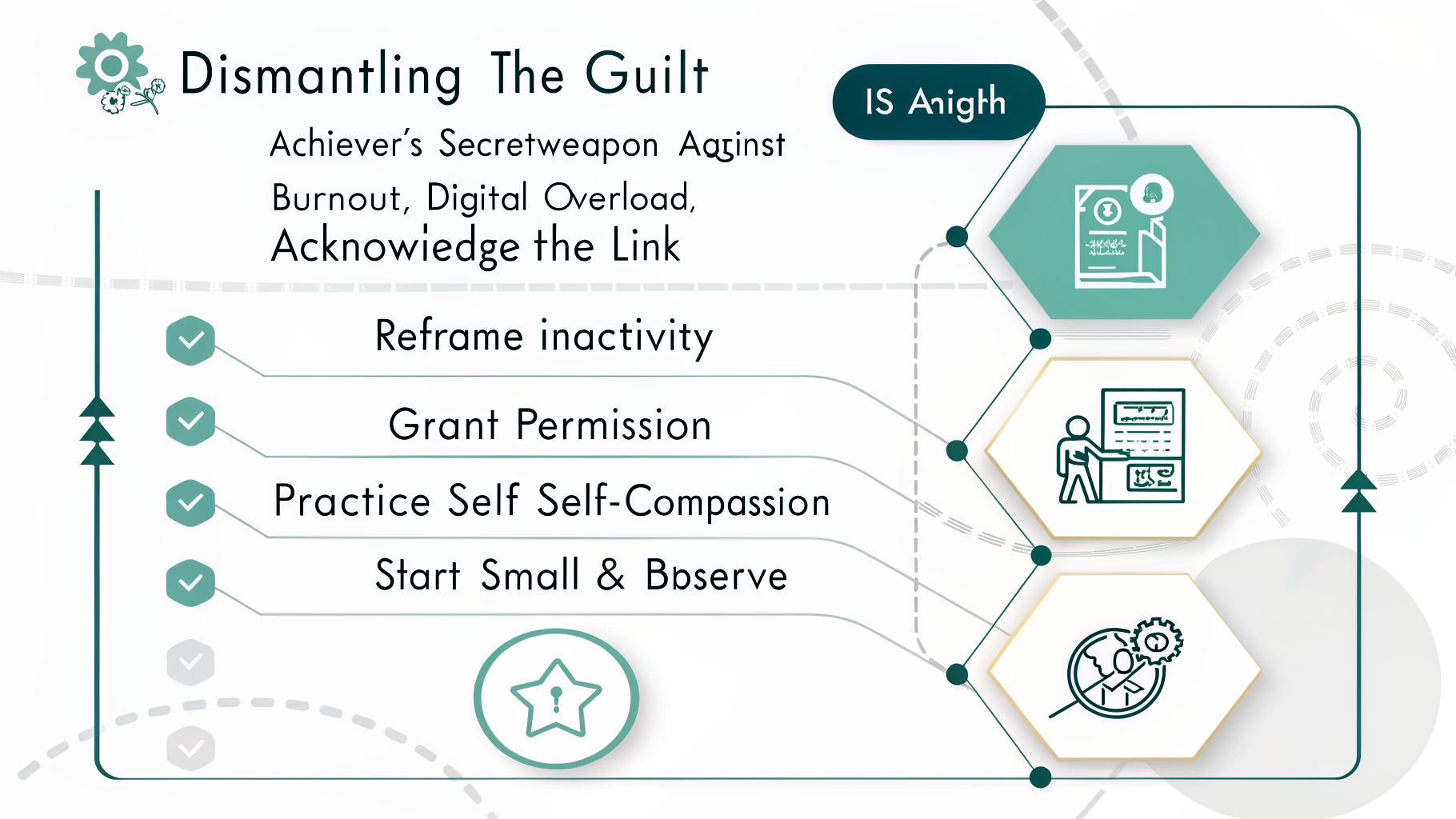 By understanding these psychological roots and actively Your 'Strategic Inactivity' Blueprint: Practical Steps for Integrating PausesYour 'Strategic Inactivity' Blueprint: Practical Steps for Integrating PausesMany high-achievers feel immense guilt when not actively working, struggling to disconnect from constant notifications. The real challenge isn't just knowing that breaks are good, but understanding how to effectively 'do nothing' or integrate meaningful pauses into an already packed schedule without feeling like you're falling behind. This blueprint offers a structured approach to integrate The Power of Pause: Why 'Doing Nothing' Is a High-Achiever's Secret Weapon Against Burnout, Digital Overload, and Decision Fatigue.
1
Audit Your Day for Micro-WindowsInstead of carving out large blocks, identify existing 5-10 minute gaps. This might be waiting for coffee, during a commute on public transit in Vancouver, or between virtual meetings. A University of Illinois study showed even short breaks significantly improve focus and reduce mental fatigue.
2
Schedule & Protect Your PauseBlock out 1-2 intentional 15-minute pauses in your digital calendar each day, treating them as non-negotiable appointments. For example, a senior marketing director in Montreal might schedule a "focus break" from 10:30-10:45 AM. Turn off email notifications and silence your phone during this time.
3
Choose Your Pause ModalityDuring these protected times, engage in specific activities that activate your Default Mode Network. This could be a short walk around the office in Calgary, 5 minutes of focused diaphragmatic breathing, or simply staring out a window without a specific task. Avoid scrolling social media; industry data indicates the average person checks their phone dozens of times daily, contributing to constant partial attention.
4
Reflect & Re-EngageBefore jumping back into work, take 60 seconds to notice any shifts in your mental state. Do you feel slightly clearer? Less tense? This brief reflection helps reinforce the positive impact of the pause, making it easier to integrate the next one. Implementing these steps isn't about adding more to your plate; it's about strategically re-allocating small Customizing Your Pause: Finding What Works for Your Unique DemandsCustomizing Your Pause: Finding What Works for Your Unique DemandsYou already know the relentless pace of high achievement. What works for one person's pause might feel like a waste of time for another. The real secret to unlocking The Power of Pause: Why 'Doing Nothing' Is a High-Achiever's Secret Weapon Against Burnout, Digital Overload, and Decision Fatigue lies in tailoring it to your unique energy rhythms and professional demands. This isn't about rigid rules; it's about smart, flexible integration. Consider the spectrum of pauses available. An active pause might involve a brisk walk around the block, like an analyst in downtown Vancouver stepping away from spreadsheets for ten minutes. A passive pause could be simply staring out a window for five minutes, letting your mind wander – a technique that activates the Default Mode Network, crucial for creative problem-solving according to ongoing neuroscience research. Experiment to see if a brief stretching session re-energizes you more than simply closing your eyes. For instance, a senior marketing manager in Montreal might find that 15 minutes of light yoga before a major client presentation significantly improves their focus, while a software developer in Calgary prefers five minutes of silent contemplation to reset their concentration. "The biggest mistake I made was thinking a 'break' had to look a certain way. Once I started listening to my own body and what it truly needed, my productivity actually soared." — Product Lead, Toronto Identifying your personal energy peaks and troughs is vital. Are you a morning sprint person, hitting a slump mid-afternoon? Or do you thrive in the evening but struggle to start your day? A 2023 study by the University of Alberta highlighted that individuals who align their most demanding tasks with their natural energy peaks, and strategically place pauses during troughs, report up to a 20% increase in sustained focus. Track your energy levels for a week using a simple journal or an app like MySerenity. You might discover that a 10-minute "brain dump" pause at 2 PM prevents a complete cognitive shutdown, or that a 25-minute power nap (if your environment allows) after lunch dramatically improves your afternoon decision-making quality. The duration and frequency of your breaks also need calibration. While a University of Illinois study showed that even 5-10 minute breaks can improve focus, a longer, less frequent pause might suit a different workflow. Try a Pomodoro-style 25/5 minute cycle for a few days, then switch to longer 90-minute work blocks followed by 20-minute breaks. The objective is to discover what revitalizes *you* most effectively, ensuring these strategic moments of inactivity become a reliable tool for sustained high performance, not another item on your to-do list. FAQ: Your Questions About Strategic Inactivity AnsweredWhen you're constantly striving for excellence, questions about stepping back naturally arise. It feels counterintuitive to pause when your to-do list seems endless, but integrating "The Power of Pause: Why 'Doing Nothing' Is a High-Achiever's Secret Weapon Against Burnout, Digital Overload, and Decision Fatigue" is a skill.Your Quick Reference Card for Strategic Pauses
How long should a strategic pause be?
Even short breaks matter. Research from the University of Illinois suggests 5-10 minute pauses can significantly improve focus on prolonged tasks. For deeper processing, aim for 20-30 minutes, like a focused walk without your phone.
Can I still be a high-achiever if I 'do nothing'?
Absolutely. High-achievers aren't defined by constant activity, but by impactful results. Intentional pauses activate your Default Mode Network, crucial for creative problem-solving and memory consolidation, making your active periods more effective.
What if my job doesn't allow frequent breaks?
Look for micro-pauses. Close your eyes for 60 seconds between meetings. Take a 2-minute walk to the water cooler. Even a brief moment away from your screen helps reset cognitive load. Schedule these in your calendar like any other appointment.
Is meditation the same as strategic inactivity?
Meditation is a form of strategic inactivity, focusing on present-moment awareness. However, strategic inactivity is broader, encompassing any intentional break from active, goal-oriented tasks – from staring out a window to a quiet walk in a Montréal park.
How do I deal with colleagues/managers who don't understand?
Frame it as a performance strategy. "I'm taking a 15-minute cognitive break to ensure I return to this project with fresh insights." You don't need to over-explain. Leading by example, demonstrating enhanced output and calmer decision-making, often speaks volumes.
What are immediate signs I need a strategic pause?
Feeling mentally foggy, re-reading emails multiple times, making impulsive decisions, or experiencing irritability are all clear signals. If you find yourself checking your phone dozens of times an hour, as Deloitte's Global Mobile Consumer Survey indicates many do, it's time to step back. Frequently Asked QuestionsWhat does "the power of pause" actually mean for high achievers?For high achievers, the power of pause isn't merely stopping work; it's a deliberate, strategic disengagement to allow cognitive processing and restoration. For instance, a CEO might schedule 15 minutes of uninterrupted silence between meetings to process complex information, rather than immediately jumping to the next task. This intentional space creates mental clarity, fosters deeper insights, and prevents decision fatigue, transforming downtime from a luxury into a critical performance tool. How can strategic "doing nothing" combat high-achiever burnout?High achievers often push through exhaustion, leading to chronic stress. Strategic "doing nothing," like a 20-minute walk without a podcast for a project manager in Vancouver, interrupts this cycle. It allows the prefrontal cortex to rest, restoring executive function and emotional regulation. This deliberate mental disengagement prevents the sustained cortisol elevation associated with burnout, helping to reset the nervous system and build resilience against the constant demands of high-pressure roles. Why is brain downtime essential for focus and productivity?Our brains require downtime to consolidate memories, process complex information, and foster creative insights. During periods of rest, such as staring out a window for five minutes, the Default Mode Network (DMN) activates, which is crucial for these cognitive functions. Without this essential downtime, sustained attention wanes, leading to increased errors, diminished returns on effort, and a struggle to maintain high-level focus on demanding tasks, like coding or strategic planning. Is it normal for successful people to feel guilty about taking breaks?Absolutely. Many successful individuals, particularly in competitive sectors like finance or medicine, internalize a belief that constant activity equals productivity. A senior surgeon in Montreal might feel immense guilt stepping away from emails, perceiving it as a lack of commitment. This feeling often stems from early career conditioning or societal pressures. Recognizing this guilt as a common, learned response, rather than a personal failing, is the first step toward embracing restorative pauses. Can short, intentional breaks really help reduce digital overload?Yes, profoundly. Even a five-minute break away from screens, like stepping outside or closing your eyes, can significantly reduce the cognitive strain of constant digital input. For a university professor grading papers online, this might mean setting a timer to look away every 25 minutes. These micro-pauses prevent the cumulative fatigue from notifications and blue light, allowing your visual and cognitive systems to reset, improving attention, and reducing irritability from digital overload. Frequently Asked QuestionsWhat does "the power of pause" actually mean for high achievers?For high achievers, the power of pause isn't merely stopping work; it's a deliberate, strategic disengagement to allow cognitive processing and restoration. For instance, a CEO might schedule 15 minutes of uninterrupted silence between meetings to process complex information, rather than immediately jumping to the next task. This intentional space creates mental clarity, fosters deeper insights, and prevents decision fatigue, transforming downtime from a luxury into a critical performance tool. How can strategic "doing nothing" combat high-achiever burnout?High achievers often push through exhaustion, leading to chronic stress. Strategic "doing nothing," like a 20-minute walk without a podcast for a project manager in Vancouver, interrupts this cycle. It allows the prefrontal cortex to rest, restoring executive function and emotional regulation. This deliberate mental disengagement prevents the sustained cortisol elevation associated with burnout, helping to reset the nervous system and build resilience against the constant demands of high-pressure roles. Why is brain downtime essential for focus and productivity?Our brains require downtime to consolidate memories, process complex information, and foster creative insights. During periods of rest, such as staring out a window for five minutes, the Default Mode Network (DMN) activates, which is crucial for these cognitive functions. Without this essential downtime, sustained attention wanes, leading to increased errors, diminished returns on effort, and a struggle to maintain high-level focus on demanding tasks, like coding or strategic planning. Is it normal for successful people to feel guilty about taking breaks?Absolutely. Many successful individuals, particularly in competitive sectors like finance or medicine, internalize a belief that constant activity equals productivity. A senior surgeon in Montreal might feel immense guilt stepping away from emails, perceiving it as a lack of commitment. This feeling often stems from early career conditioning or societal pressures. Recognizing this guilt as a common, learned response, rather than a personal failing, is the first step toward embracing restorative pauses. Can short, intentional breaks really help reduce digital overload?Yes, profoundly. Even a five-minute break away from screens, like stepping outside or closing your eyes, can significantly reduce the cognitive strain of constant digital input. For a university professor grading papers online, this might mean setting a timer to look away every 25 minutes. These micro-pauses prevent the cumulative fatigue from notifications and blue light, allowing your visual and cognitive systems to reset, improving attention, and reducing irritability from digital overload. Keep readingAll articles → Doctor's Guide: Best AI Mental Wellness Apps for High-AchieversFor high-achievers battling burnout and decision fatigue, the real challenge isn't finding an app, but rather discerning which of the "best AI mental wellness apps" offer personalized, evidence-based support beyond simple meditation. These tools address specific stressors like perfectionism or performance anxiety.  High-Achiever's Blueprint: 7 Evidence-Based Anxiety Coping StrategiesMany high-achievers see anxiety as an unavoidable cost of ambition. However, clinically proven evidence based anxiety coping strategies offer significant symptom reduction, refining your internal operating system for success.  Strategic Mood Tracking: How to Effectively Track Your Mood for Burnout & Anxiety ManagementMany find basic mood logging unhelpful for preventing burnout. This guide transforms mood tracking into a strategic process for proactive self-management. |