

Brené Brown's #1 Strategy: Prevent Burnout for High-Achievers
Many high-achievers assume resilience is about 'toughing it out,' yet this mindset often accelerates burnout. Brené Brown's #1 strategy for high-achievers to prevent burnout isn't about grit; it's about cultivating wholeheartedness through vulnerability.

Your Path to Sustainable Success: An Overview of Brené Brown's Burnout Strategy
Your Path to Sustainable Success: An Overview of Brené Brown's Burnout Strategy
Many high-achievers assume resilience is about "toughing it out" or simply bouncing back, yet this mindset often accelerates burnout rather than preventing it. Brené Brown's #1 evidence-based strategy for high-achievers to prevent burnout isn't about grit in isolation; it's about cultivating wholeheartedness through vulnerability and courage. This approach directly counters the perfectionism and shame that typically plague high-performers, leading to chronic exhaustion and detachment from work, a state the World Health Organization recognized in 2019 as an occupational phenomenon.
Traditional resilience advice often falls short for those pushing boundaries, like a senior marketing director in Calgary juggling a global product launch and a growing team. They might intellectualize "stress reduction" but struggle to implement it without feeling weak. Brown's work offers a deeper solution, moving beyond surface-level coping mechanisms. It provides a three-step framework that integrates vulnerability, courage, and wholehearted living directly into a high-pressure professional life, addressing the root causes of energy depletion rather than just the symptoms.
This guide translates Brown's extensive research into concrete, actionable steps. You'll gain practical tools to address common high-achiever roadblocks, such as the fear that showing imperfection will derail a promotion or compromise a reputation. By understanding and applying these strategies, you can build a career and life rich in meaning and impact, sidestepping the burnout trajectory that claims roughly 60-70% of professionals in demanding roles.
Understanding Burnout & Why 'Toughing It Out' Fails High-Achievers
You're likely here because the usual advice—"just tough it out" or "build more resilience"—feels hollow, maybe even insulting, given your demanding career. The truth is, for high-achievers like a senior software architect in Vancouver or an ER doctor in Montreal, simply "bouncing back" often fails because it misunderstands the true nature of burnout and the unique psychological hurdles you face.
Burnout isn't just everyday stress or fatigue; it's a specific occupational phenomenon. The World Health Organization (WHO) recognized it in 2019, defining it by three core dimensions: profound exhaustion, increased mental distance or cynicism toward one's job, and reduced professional efficacy. Research consistently indicates that high-achievers are particularly susceptible. Your drive for perfection, intense pressure to perform, and often a deep-seated fear of failure can lead you to neglect essential self-care and boundary setting. For instance, a marketing director at a top Toronto firm might work 70-hour weeks, believing any slowdown signals weakness, pushing past the point of no return.
"We tell our people to be resilient, but then we don't give them the space or the safety to actually process what's burning them out in the first place." — kindergarten administrator, Toronto
This is precisely where traditional resilience advice falls short, missing the deeper psychological barriers. Brené Brown's work offers a more nuanced, evidence-based strategy, moving beyond superficial coping mechanisms to address the core issues that make high-achievers vulnerable to burnout. Her approach, which we'll explore as More Than Resilience: Brené Brown's #1 Evidence-Based Strategy for High-Achievers to Prevent Burnout, pivots on understanding that true strength isn't about avoiding vulnerability, but engaging with it skillfully.
Brené Brown's Core Insight: What True Resilience Really Means

Brené Brown's Core Insight: What True Resilience Really Means
Many high-achievers believe resilience means silently enduring hardship, pushing through exhaustion, and never showing weakness. However, Brené Brown's decades of research into shame, vulnerability, and courage offer a contrarian view: true resilience isn't about 'toughing it out' at all. Instead, it's about the profound capacity to rise from adversity with wisdom, integrating lessons from struggle rather than just trying to forget them. This distinction is crucial for understanding More Than Resilience: Brené Brown's #1 Evidence-Based Strategy for High-Achievers to Prevent Burnout.
Her work, spanning over 20 years and involving thousands of interviews, highlights that genuine strength comes from embracing vulnerability, practicing self-compassion, and cultivating shame resilience. This isn't about 'bouncing back' to the same place, but 'bouncing forward with wisdom,' a concept that resonates deeply with professionals in demanding fields like tech in Waterloo or healthcare in Vancouver, where the pressure to perform can lead to significant emotional depletion. It's a more robust framework than generic self-help advice, which often overlooks the psychological underpinnings of sustained well-being.
"We used to tell our teams to just 'power through' difficult periods, but Brown's work made us realize that only led to more burnout, not less. We needed a different kind of strength." — Senior HR Director, Calgary
This approach directly counters the traditional, often damaging, narrative that high-achievers must be impenetrable. It sets the stage for a strategy that addresses the core reasons burnout takes hold, moving beyond surface-level coping mechanisms to foster deep, sustainable well-being.
Deconstructing Brené Brown's #1 Strategy: Vulnerability, Courage, and Wholeheartedness
Many high-achievers mistakenly believe that preventing burnout requires them to build an impenetrable wall of stoicism, when in fact, Brené Brown's research points to the opposite: a courageous openness. Her primary strategy isn't about simply bouncing back from stress, but about cultivating a deeper, more sustainable way of being that actively inoculates against depletion. It's truly More Than Resilience: Brené Brown's #1 Evidence-Based Strategy for High-Achievers to Prevent Burnout.
This approach hinges on three interconnected concepts: vulnerability, courage, and wholeheartedness. Vulnerability isn't a weakness; it's the willingness to show up authentically, even when the outcome is uncertain. For instance, a senior product manager in Vancouver might admit to her team that she's struggling to meet a tight deadline, rather than silently working 80-hour weeks. This act of vulnerability requires courage—the discomfort of uncertainty and emotional exposure. When you commit to wholehearted living, you engage with your work and relationships from a place of inherent worthiness, fostering the connection and meaning that research, like a 2018 study in the Journal of Applied Psychology on self-compassion, shows directly counters the emotional and physical depletion of burnout. It’s about building a life where your value isn't tied solely to your output.
"Burnout isn't just about being tired; it's about feeling disconnected from the purpose that once drove you. Vulnerability helps us reconnect." — HR Director, Calgary
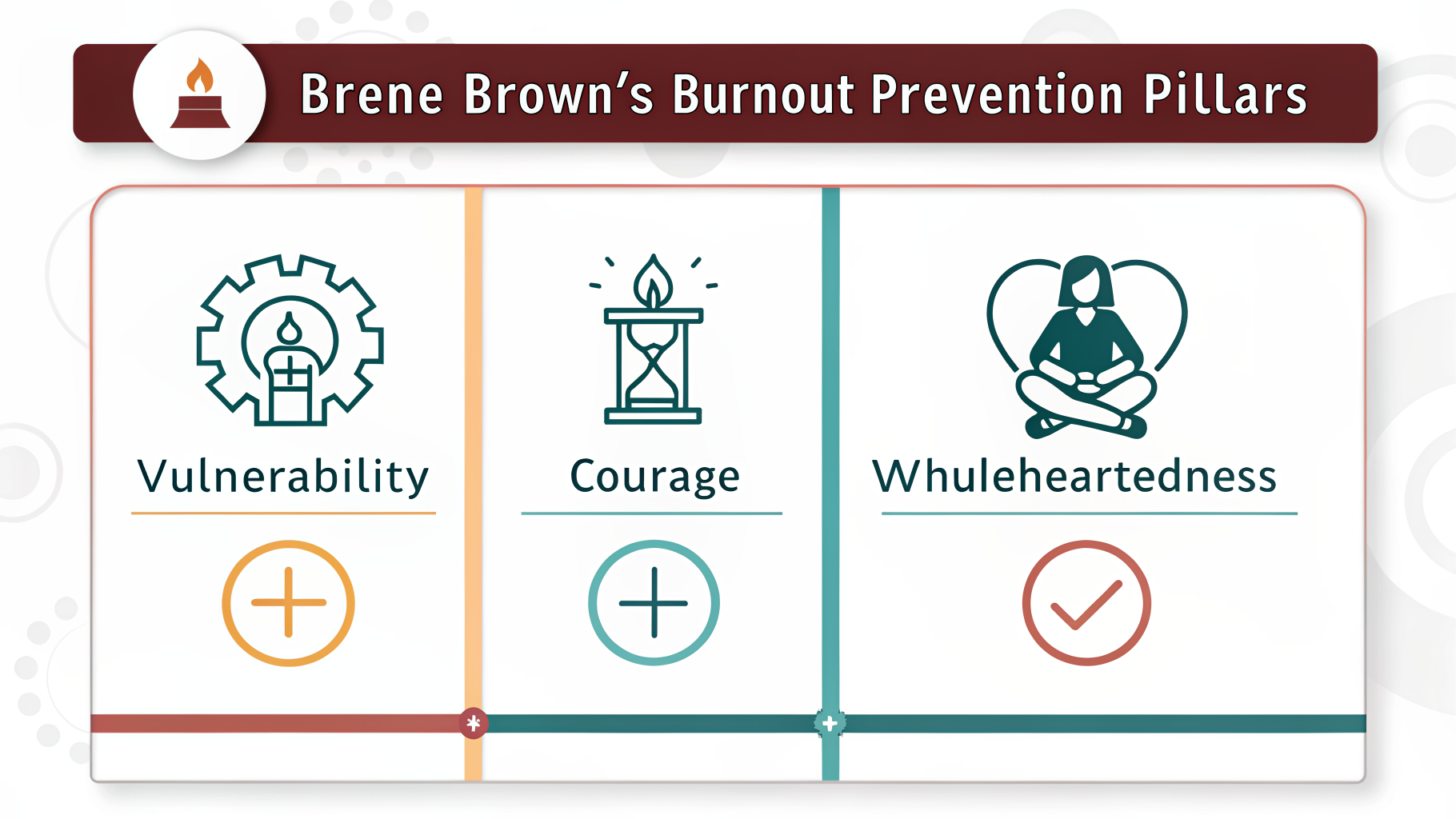
Understanding these elements provides the "why" for high-achievers seeking data-driven strategies. Instead of viewing these as soft skills, consider them active mechanisms for psychological self-preservation, directly addressing the isolation and emotional exhaustion recognized by the World Health Organization as hallmarks of occupational burnout.
Implementing Brené Brown's Strategy: A 3-Step Framework for High-Achievers
High-achievers often find themselves stuck, understanding Brené Brown's concepts in theory but struggling with practical application. The real work of preventing burnout, especially for those driven by success, means translating abstract ideas like vulnerability into concrete, daily actions. This 3-step framework offers a systematic way to integrate More Than Resilience: Brené Brown's #1 Evidence-Based Strategy for High-Achievers to Prevent Burnout into your professional and personal life.
Cultivate Self-Awareness & Emotional Literacy
Recognize the specific emotional triggers that drive overwork. For instance, a senior marketing manager in Vancouver might notice they feel inadequate after missing a client deadline, leading them to work late every night that week. Journal for 10 minutes daily, reflecting on moments of discomfort or self-criticism. This practice, supported by research on self-compassion published in the Journal of Applied Psychology (2018), helps clarify internal burnout triggers.
Practice Vulnerability with Discernment
Choose one trusted colleague or mentor to share a professional struggle or ask for help. This isn't about oversharing, but about demonstrating courage. A software architect in Toronto could admit to a project lead, "I'm struggling to meet this coding deadline; could we review the scope?" This builds trust, reduces the burden of perfectionism, and fosters genuine connection.
"Asking for help isn't a sign of weakness; it's a sign that you understand the value of collaboration and your own limits." — HR director, Calgary
Set Boundaries & Engage in Wholehearted Living
Define non
For high-achievers, the path to preventing burnout with Brené Brown's strategies often hits specific psychological walls. The belief that vulnerability equals weakness, for instance, is deeply ingrained in many corporate cultures, from Bay Street to Calgary's energy sector. This section addresses those internal barriers head-on. Recognizing progress in preventing burnout isn't always about grand breakthroughs; often, it's a collection of subtle, yet powerful, shifts in your daily experience. For high-achievers, these markers indicate you’re truly embodying More Than Resilience: Brené Brown's #1 Evidence-Based Strategy for High-Achievers to Prevent Burnout. You find yourself approaching projects with renewed interest, rather than the detached negativity or exhaustion the World Health Organization identifies as a core burnout symptom. For example, a senior product manager in Calgary might notice genuine excitement for a new feature launch, instead of just seeing it as another task. Observe your capacity to decline non-essential requests without guilt. This might look like a marketing director in Vancouver confidently saying "no" to a weekend project that doesn't align with their strategic priorities, protecting their personal time. When setbacks occur, you respond with kindness, not harsh self-criticism. Research in the Journal of Applied Psychology (2018) links self-compassion to moderating work stress and burnout. Instead of berating yourself for a missed deadline, you acknowledge the challenge and focus on next steps. True resilience means learning and growing from adversity, not just recovering. After a project failure, a tech lead in Toronto might analyze what went wrong, adapt their process, and integrate those lessons into future work, emerging wiser. Beyond tasks, you connect with the 'why' behind your work, finding deeper meaning. This shift combats both burnout and "rust-out" (under-
Many high-achievers find themselves caught in a paradox: the strategies that prevent burnout often feel like they might also prevent success. Yet, Brené Brown's framework offers a path to move beyond merely avoiding exhaustion, toward actively cultivating a life rich in meaning and purpose. This isn't just about stress reduction; it's about transforming your relationship with work itself. You’re not just guarding against burnout, but also against "rust-out"—the under-stimulation and lack of meaning that can plague even successful careers. Consider a senior software architect in Vancouver, Alex, who felt unfulfilled despite his impressive salary. By embracing the principles of More Than Resilience: Brené Brown's #1 Evidence-Based Strategy for High-Achievers to Prevent Burnout, Alex started advocating for projects aligned with his values, shifting from passive task completion to leading initiatives he deeply cared about. This focus on meaning, not just output, is critical. Research consistently shows that a strong sense of purpose significantly moderates the relationship between work demands and feelings of depletion. Integrating authenticity and courage into your professional identity fosters sustainable success and leadership. When you lead with your whole self, as Brown suggests, you create a ripple effect. A manager in a Calgary financial firm who openly shared a professional setback, rather than hiding it, found her team responded with increased trust and collaboration, fostering a healthier, more transparent work environment for all. This approach allows you to achieve profound impact without the constant threat of depletion, building a legacy that extends far beyond your achievements. Brené Brown's primary strategy for high-achievers to prevent burnout isn't simply 'toughing it out,' but cultivating courageous vulnerability and wholehearted living. This involves setting clear boundaries, asking for help, and embracing imperfection, rather than striving for an unsustainable ideal. For instance, a senior software engineer in Vancouver might openly admit needing an extension on a complex project, fostering team trust instead of silently struggling and risking exhaustion. Brown argues that vulnerability helps high-achievers avoid burnout by fostering genuine connection and reducing the isolating burden of perfectionism. When you allow yourself to be seen, imperfections and all, you build stronger support networks and access empathy. A marketing director in Calgary, for example, might share their struggles with work-life balance, finding colleagues who offer practical solutions or simply understanding, rather than feeling alone in their stress. Traditional 'tough it out' methods often fail high-achievers because they promote isolation and suppress authentic emotions, which are critical for sustainable well-being. This approach can lead to chronic stress, shame, and deeper burnout, as individuals internalize struggles rather than seeking support. A lawyer in Toronto, constantly pushing through exhaustion without acknowledging their limits, might eventually face severe anxiety or physical health issues, rather than finding healthy coping mechanisms. Yes, Brené Brown's definition of resilience significantly differs from the common understanding of simply 'bouncing back.' She defines it as 'bouncing forward' – the ability to adapt and grow through adversity with self-compassion and support, rather than just enduring. For a university professor in Montreal, this means processing the disappointment of a rejected grant application with empathy for themselves, learning collaboratively from the feedback, and then moving forward with renewed, supported effort. Absolutely. Brown's strategies directly address perfectionism and shame, which often fuel burnout in high-achievers. By practicing self-compassion, understanding the difference between healthy striving and perfectionism, and cultivating empathy, individuals can disarm their inner critic. A product manager at a tech startup, prone to overworking to avoid perceived failure, can learn to share early-stage ideas for feedback, reducing the pressure for a 'perfect' launch and mitigating shame. For high-achievers battling burnout and decision fatigue, the real challenge isn't finding an app, but rather discerning which of the "best AI mental wellness apps" offer personalized, evidence-based support beyond simple meditation. These tools address specific stressors like perfectionism or performance anxiety. Many high-achievers see anxiety as an unavoidable cost of ambition. However, clinically proven evidence based anxiety coping strategies offer significant symptom reduction, refining your internal operating system for success. Many find basic mood logging unhelpful for preventing burnout. This guide transforms mood tracking into a strategic process for proactive self-management.Overcoming High-Achiever Roadblocks: Shame, Perfectionism, and Fear of Not Enough

Overcoming High-Achiever Roadblocks: Shame, Perfectionism, and Fear of Not Enough
Why Vulnerability Feels Risky (and Why It Isn't)
Shame Resilience: Your Burnout Prevention Tool
Measuring Your Progress: Signs You're Building Sustainable Resilience
Signs You're Building Sustainable Resilience
Beyond Prevention: Cultivating a Life of Meaning and Impact Without Burnout
Beyond Prevention: Cultivating a Life of Meaning and Impact Without Burnout
"True success isn't just about reaching the summit; it's about whether you still recognize yourself, and your values, when you get there." — Senior Vice-President, Global Marketing Firm, Toronto
Frequently Asked Questions
What is Brené Brown's top strategy for high-achievers to prevent burnout?
How can vulnerability help high-achievers avoid burnout according to Brené Brown?
Why do traditional 'tough it out' methods fail high-achievers experiencing burnout?
Is Brené Brown's definition of resilience different from common understanding?
Can high-achievers overcome perfectionism and shame with Brené Brown's strategies?
Frequently Asked Questions
What is Brené Brown's top strategy for high-achievers to prevent burnout?
How can vulnerability help high-achievers avoid burnout according to Brené Brown?
Why do traditional 'tough it out' methods fail high-achievers experiencing burnout?
Is Brené Brown's definition of resilience different from common understanding?
Can high-achievers overcome perfectionism and shame with Brené Brown's strategies?
Keep reading
All articles →
Doctor's Guide: Best AI Mental Wellness Apps for High-Achievers

High-Achiever's Blueprint: 7 Evidence-Based Anxiety Coping Strategies

Strategic Mood Tracking: How to Effectively Track Your Mood for Burnout & Anxiety Management