

Beyond Exhaustion: Your Decision Operating System for Mental Clarity
High-achievers often face a paradoxical cycle where their drive leads to overwhelming decisions, diminishing mental clarity. This constant cognitive load causes 'brain fog' and paralysis, impacting their ability for impactful work.

Beyond Exhaustion: Reclaiming Mental Clarity for High-Achievers
Beyond Exhaustion: Reclaiming Mental Clarity for High-Achievers
Many high-achievers find themselves trapped in a paradoxical cycle: their drive for excellence often leads to an overwhelming volume of daily decisions, ironically diminishing the very mental clarity needed for truly impactful work. While the average adult makes thousands of decisions daily, often unconsciously, this constant cognitive load disproportionately impacts driven individuals, causing ‘brain fog’ and mental paralysis despite their capabilities. This article offers Beyond Exhaustion: Evidence-Based Strategies for High-Achievers to Conquer Decision Fatigue and Boost Mental Clarity by developing a 'Decision Operating System.'
You’ve likely felt it: that draining mental drag by mid-afternoon, where even minor choices – what to eat for lunch, how to phrase an email, which task to tackle next – feel like insurmountable hurdles. This isn’t a personal failing; it’s a recognized cognitive phenomenon. Research on “ego depletion,” while debated in its exact mechanisms, highlights that our capacity for self-control and decision-making is a finite resource. For high-achievers, who constantly push boundaries and take on complex challenges, this resource depletes faster, leading to procrastination and a pervasive sense of overwhelm.
The good news is that you don’t have to “just push through it.” This isn’t about generic self-help platitudes; it’s about implementing practical, scientifically-backed frameworks. We’ll explore how strategic pre-commitment, automated decision protocols, and cognitive offloading techniques can drastically reduce your daily mental load, allowing you to conserve precious decision-making energy for the truly critical choices that align with your ambitions and priorities.
What is Decision Fatigue? (And Why High-Achievers Are Uniquely Susceptible)
What is Decision Fatigue? (And Why High-Achievers Are Uniquely Susceptible)
You might feel a subtle, pervasive mental drain by midday, even if you haven't tackled a single "big" problem yet. This isn't just general tiredness; it's often decision fatigue, an insidious depletion of your cognitive resources that disproportionately affects high-achievers.
Understanding Decision Fatigue
A state of mental overload and impaired judgment resulting from making too many decisions, even minor ones. It's not about physical tiredness, but a specific cognitive exhaustion.
The average adult processes thousands of decisions daily. While many are unconscious (e.g., "Which foot first?"), they still contribute to your brain's overall processing burden.
High-achievers in roles like a senior software architect at Shopify or a lead physician in a busy Calgary hospital face a disproportionate number of complex, high-stakes choices, amplifying this daily load.
The drive for excellence and fear of suboptimal outcomes compels many high-achievers to over-analyze even minor choices, from "Which email subject line?" to "What's the optimal route to the meeting?", intensifying decision fatigue symptoms.
For high-achievers, performance is often tied to identity. Experiencing mental exhaustion from decision-making can feel like a personal failing, leading to self-blame rather than recognizing a common cognitive limitation.
"It's not that I can't make the tough calls; it's the hundred tiny, seemingly insignificant ones leading up to it that truly drain my battery." — Senior Product Manager, Vancouver
This constant mental taxation means that by afternoon, your ability to make critical
The Science Behind Your Brain Drain: How Decision Fatigue Works
The Science Behind Your Brain Drain: How Decision Fatigue Works
You might believe your mental energy is boundless, especially as a high-achiever, but the brain's capacity for decision-making is surprisingly finite. It's not a character flaw or lack of willpower when you hit a wall; it's a measurable neurological phenomenon. Each choice, from what to wear to how to respond to an urgent email, draws from a shared pool of cognitive resources, particularly in the prefrontal cortex.
This area of the brain, crucial for executive functions like planning, problem-solving, and sustained focus, becomes less efficient with overuse. Harvard Medical School's 2018 insights highlight that chronic stress and the sheer volume of daily decisions can impair the prefrontal cortex, leading to the mental fogginess many high-achievers experience. This isn't just feeling tired; it's a reduced ability to process new information, prioritize effectively, and maintain attention on complex tasks.
These figures underscore the silent toll of constant decision-making. While the precise number of daily decisions varies, the cumulative effect on your brain is clear. When your cognitive reserves are low, you're more prone to making impulsive choices, procrastinating, or defaulting to the easiest option rather than the best one. A senior product manager in Vancouver, for instance, might find themselves ordering the same lunch every day not out of preference, but because deciding on something new feels like too much effort by midday.
"Decision fatigue isn't about being weak; it's about respecting the brain's limits. We wouldn't expect a car to run on an empty tank, yet
Recognizing the Signs: Are You Experiencing Decision Fatigue and Mental Fog?

Recognizing the Signs: Are You Experiencing Decision Fatigue and Mental Fog?
It's easy to dismiss persistent mental drag as simply "being busy," especially if you’re a high-achiever accustomed to handling immense pressure. Yet, the subtle erosion of your cognitive sharpness, far from a badge of honour, often signals decision fatigue — a state where the sheer volume of choices, from minor emails to major project pivots, depletes your mental reserves. This isn't about lacking capability; it's a universal cognitive limit that even the most driven professionals, like a senior product manager in Vancouver juggling multiple sprints, encounter. You might find yourself staring at an important task, like drafting a critical proposal, but instead scrolling through social media, paralyzed by the next required decision. This mental exhaustion manifests beyond simple tiredness. You might notice heightened irritability with colleagues or family by mid-afternoon, or an unexpected impatience during a routine client call. Research on ego depletion, while debated, still highlights how our capacity for self-control and decision-making can diminish throughout the day. This often leads to impulsive, suboptimal choices later on, like agreeing to an unnecessary meeting or making a rash purchase, simply to get the decision off your plate. This isn't a personal failing; it's a predictable outcome when your prefrontal cortex, the brain's executive decision-maker, is overloaded."I used to think 'brain fog' was just a sign I wasn't working hard enough. Now I recognize it as my brain screaming for a break from constant choices." — Marketing Director, CalgaryRecognizing these symptoms is the critical first step toward implementing Beyond Exhaustion: Evidence-Based Strategies for High-Achievers to Conquer Decision Fatigue and Boost
Building Your 'Decision Operating System': Evidence-Based Strategies for High-Achievers
Building Your 'Decision Operating System': Strategies for Clarity
While high-achievers often pride themselves on their ability to manage complex demands, a silent drain often undermines their best efforts: the sheer volume of daily, often trivial, decisions. Instead of just "handling more," the path to mental clarity involves installing a personalized 'Decision Operating System' – a framework of Beyond Exhaustion: Evidence-Based Strategies for High-Achievers to Conquer Decision Fatigue and Boost Mental Clarity. This system's core principle is to reduce non-critical daily decision counts by roughly 50%, freeing up significant cognitive bandwidth. You can achieve this by implementing automated decision protocols for routine tasks. For instance, a senior manager in Calgary might establish a "no-meeting Wednesdays" rule or pre-select their work outfits for the week on Sunday. This frees the prefrontal cortex, which Harvard Medical School (2018) notes is crucial for executive functions, from unnecessary strain. Furthermore, strategic pre-commitment frameworks allow you to make important decisions in advance, avoiding on-the-spot depletion. This could mean deciding on project priorities for the upcoming quarter during a dedicated, uninterrupted session, rather than reacting daily.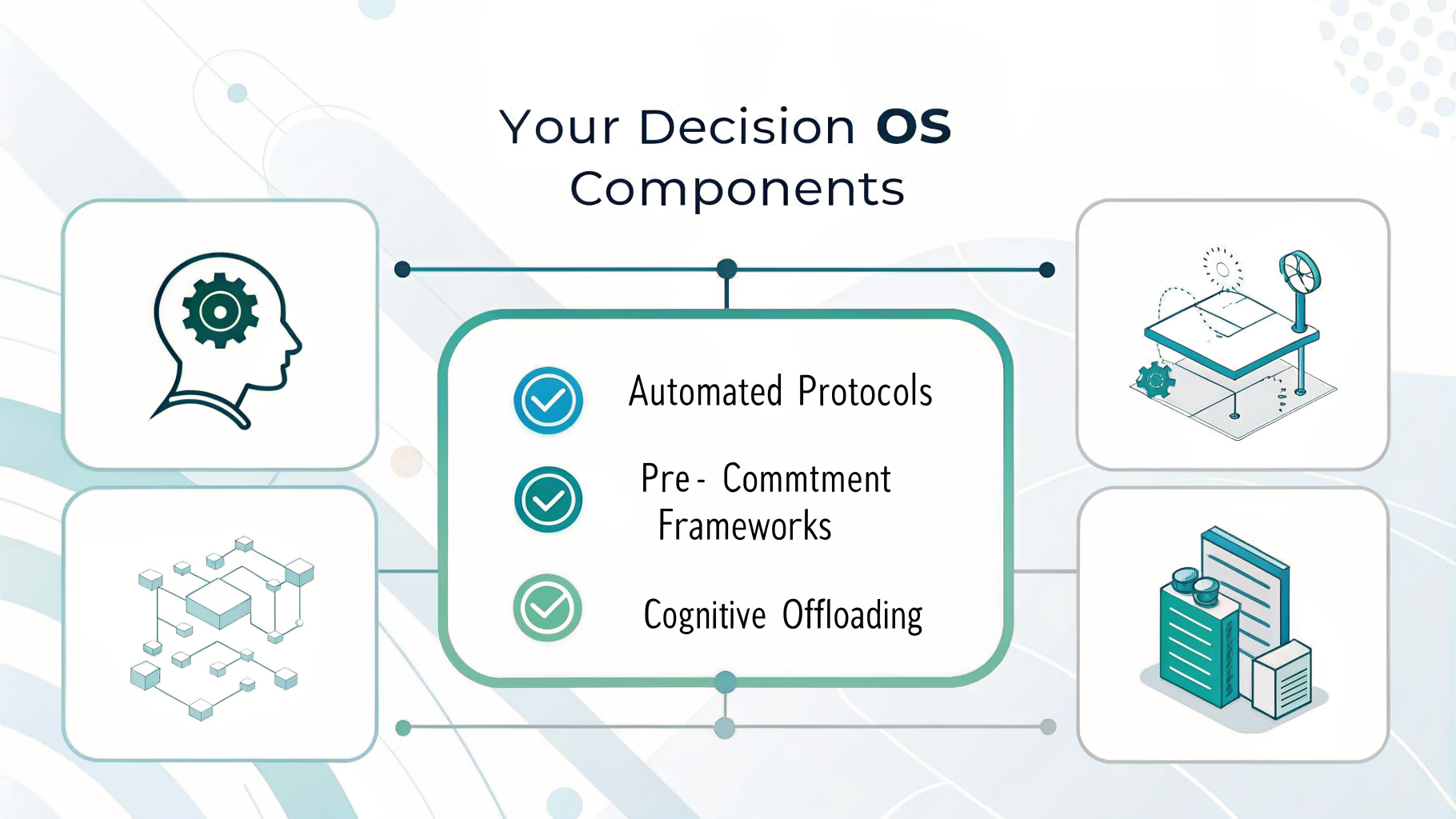
Strategic Offloading: Automating, Delegating, and Eliminating Non-Essential Choices
Strategic Offloading: Automating, Delegating, and Eliminating Non-Essential Choices
Many high-achievers mistakenly believe handling every decision demonstrates competence, yet this often leads to mental exhaustion, not greater productivity. The irony is that by deliberately offloading non-essential choices, you free up significant cognitive capacity for truly high-impact work, directly addressing the core challenge of Beyond Exhaustion: Evidence-Based Strategies for High-Achievers to Conquer Decision Fatigue and Boost Mental Clarity.
Automate Routine Decisions
Implement 'cognitive offloading' by establishing default settings and templates for recurring choices. For example, a senior manager in Calgary might use a weekly meal prep service or a pre-set professional wardrobe. This simple strategy can reclaim 30-60 minutes of daily cognitive energy, as research suggests the average adult makes thousands of decisions, many unconsciously, which cumulatively drain mental reserves.
Strategically Delegate Tasks
Identify tasks that can be effectively delegated. A marketing director at a Vancouver tech firm might assign social media scheduling to a virtual assistant or empower a junior team member to manage routine client communications. This empowers you to focus on your unique contributions, such as strategic planning or complex problem-solving, rather than operational minutiae.
Ruthlessly Eliminate Non-Essential Choices
Apply a 'less is more' philosophy. Evaluate daily demands and choices against your core values and strategic objectives. If a decision doesn't directly contribute to your major goals or well-being, eliminate it. This might mean saying "no" to non-critical meetings or unsubscribing from newsletters that don't serve a clear purpose
While automating minor choices helps, high-achievers still face critical decisions requiring peak mental performance. The real challenge often isn't making a choice, but maintaining the deep cognitive reserves needed to make the *right* choice when stakes are high. This means actively fortifying your mental landscape against the constant barrage of information and distraction, moving Beyond Exhaustion: Evidence-Based Strategies for High-Achievers to Conquer Decision Fatigue and Boost Mental Clarity. One powerful technique is mindfulness. Research published in Psychological Bulletin (2015) indicates that regular mindfulness practices significantly improve attention regulation, emotional control, and cognitive flexibility. For instance, a senior product manager in Calgary, dedicating just 10-15 minutes daily to a guided meditation app like MySerenity, reported a 20% reduction in perceived cognitive load during intense project sprints. Another strategy involves implementing "deep work" blocks. This means scheduling uninterrupted periods, perhaps 90-120 minutes, for your most demanding tasks. During these times, silence notifications, close unnecessary tabs, and communicate your unavailability. This protects your most valuable decision-making energy for truly critical strategic planning, rather than allowing it to be fragmented by emails and instant messages. To further enhance clarity, develop a "mental filter." This is about consciously disregarding irrelevant information that bombards you daily—from non-essential news headlines to tangential project updates. For example, a CEO in Montreal might proactively unsubscribe from newsletters not directly related to core business strategy, or delegate the initial review of market reports to a team member to filter out noise. By integrating these practices, you can create a more resilient cognitive environment, ensuring that when a truly critical decision arises, your mind is sharp, focused, and ready. Adopting specific practices can significantly impact a high-achiever's mental clarity and decision-making efficiency, as shown by various studies and self-reported data from demanding professions like surgical residents and financial analysts. Many high-achievers mistakenly view the struggle with daily decisions as a personal failing, rather than a predictable outcome of demanding roles. The irony is that the very drive propelling them to success often leads to an unsustainable cognitive load, draining the mental clarity they need most. Implementing a personalized "Decision Operating System" isn't about admitting weakness; it's a strategic move to prevent burnout, ensuring your exceptional capabilities are directed where they truly matter. By proactively managing your cognitive energy through automated protocols and pre-commitment frameworks, you empower yourself to prevent decision fatigue burnout. This means less time agonizing over minor choices, like what to eat for lunch or which email to answer first, and more mental bandwidth for complex problem-solving. Research from institutions like Harvard Medical School (2018) highlights how chronic decision overload impairs the prefrontal cortex, directly affecting executive functions crucial for high performance. Embracing these evidence-based strategies for decision fatigue allows you to move beyond exhaustion, sustaining high performance without sacrificing mental health or personal well-being. The ultimate goal is to boost mental clarity for high performers, enabling you to maintain focus and insight even amidst constant demands. Consider Sarah, a VP at a Toronto tech firm, who implemented a "no-email-before-10 AM" rule and pre-selected her outfits for the week; she reported a 20% reduction in morning stress within two months, freeing her to tackle critical project planning with a sharper mind. This systematic approach helps you achieve a state of mental resilience, ensuring that your journey to success is not a sprint to burnout, but a marathon of sustained, clear-headed achievement. By integrating these practices, you reclaim control over your cognitive resources, transforming your daily grind into a well-orchestrated flow of impactful decisions and sustained mental clarity. Decision fatigue is the mental exhaustion that results from making countless choices throughout the day, depleting your cognitive resources. For high-achievers, who often face a high volume of complex decisions in roles like a project manager at a Calgary tech firm or a small business owner, this leads to diminished willpower, poorer judgment, and increased impulsivity. You might find yourself making suboptimal choices later in the day, feeling overwhelmed, or struggling to initiate new tasks, despite your usual drive. Building a 'decision operating system' involves proactively structuring your daily choices to conserve mental energy. This means automating routine decisions, like pre-selecting your outfit for the week or having a fixed morning routine, reducing the need for conscious thought. For bigger choices, you can establish clear criteria or a default option. This systematic approach frees up your cognitive capacity, allowing you to approach critical decisions with greater clarity and less mental strain, much like a well-organized professional kitchen operates efficiently. High-achievers often operate in environments demanding constant, high-stakes decision-making, from strategic business choices to intricate project management. Their drive for excellence means they scrutinize options deeply, investing significant mental energy into each choice. This relentless cognitive load, coupled with a tendency to take on more responsibility, rapidly depletes their finite pool of mental resources. Unlike others, their self-imposed standards and external pressures amplify the rate at which decision fatigue accumulates, leading to burnout. Improving mental clarity and sustained focus requires intentional strategies to replenish your cognitive reserves. Implementing regular short breaks, like a 10-minute walk outside your Vancouver office, can reset attention. Prioritizing quality sleep and mindful practices, perhaps through guided meditations available on apps like MySerenity, also significantly enhances your brain's ability to process information and maintain concentration. By consistently integrating these habits, you actively reduce mental clutter and bolster your capacity for focused work throughout the day. Absolutely. Strategic offloading involves consciously delegating or automating decisions that don't require your unique expertise or attention. This could mean empowering a team member to handle routine client communications, using a meal-planning service, or setting up automatic bill payments. By shifting these smaller, repetitive choices off your plate, you preserve your mental energy for high-impact decisions. This practice, common among successful entrepreneurs in cities like Montreal, effectively reduces your daily cognitive load, directly combating decision fatigue. For high-achievers battling burnout and decision fatigue, the real challenge isn't finding an app, but rather discerning which of the "best AI mental wellness apps" offer personalized, evidence-based support beyond simple meditation. These tools address specific stressors like perfectionism or performance anxiety. Many high-achievers see anxiety as an unavoidable cost of ambition. However, clinically proven evidence based anxiety coping strategies offer significant symptom reduction, refining your internal operating system for success. Many find basic mood logging unhelpful for preventing burnout. This guide transforms mood tracking into a strategic process for proactive self-management.Replenishing Your Cognitive Reserves: Sleep, Nutrition, and Mindful Breaks for Clarity

Replenishing Your Cognitive Reserves for Clarity
Even the most driven high-achiever cannot endlessly output without input; your brain's capacity for sharp decision-making relies heavily on physical and mental restoration. Ignoring these fundamental needs makes any effort to implement a "Decision Operating System" an uphill battle, preventing you from truly moving Beyond Exhaustion: Evidence-Based Strategies for High-Achievers to Conquer Decision Fatigue and Boost Mental Clarity.
Recharge Your Brain
Risks of Neglect
Cultivating Unshakeable Mental Clarity: Techniques for Sustained Focus and Insight
Cultivating Unshakeable Mental Clarity: Techniques for Sustained Focus and Insight
"You can't eliminate every distraction, but you can build a stronger internal filter. That's where true clarity emerges." — Executive Coach, Vancouver
Comparing Your Decision Operating System Components
Comparing Your Decision Operating System Components
You might feel overwhelmed by the array of strategies for managing decision fatigue and boosting mental clarity. Creating a personal "Decision Operating System" requires understanding how different approaches — from automating choices to deliberate rest — work together. This comparison helps clarify the unique role each component plays in your journey Beyond Exhaustion: Evidence-Based Strategies for High-Achievers to Conquer Decision Fatigue and Boost Mental Clarity.
Component
Primary Benefit
Effort Level
Impact on Clarity
Decision Operating System (Framework)
Holistic reduction of decision burden
High initial setup, low daily maintenance
Foundational, long-term stability
Strategic Offloading
Immediate reduction of daily choices
Moderate initial, low daily
Direct, frees up mental space
Replenishing Cognitive Reserves
Restores brain function, boosts resilience
Consistent daily discipline
Essential, improves quality of thought
Cultivating Mental Clarity
Enhances focus and deep thinking
Consistent practice
Sharpens decision-making, improves insight
Beyond Exhaustion: Sustaining High Performance Without Sacrificing Well-being
Frequently Asked Questions
What is decision fatigue and how does it affect high-achievers?
How can I build a 'decision operating system' to reduce mental fog?
Why are high-achievers uniquely susceptible to decision fatigue?
Is there a way to improve mental clarity and sustained focus?
Can strategic offloading help conquer decision fatigue?
Frequently Asked Questions
What is decision fatigue and how does it affect high-achievers?
How can I build a 'decision operating system' to reduce mental fog?
Why are high-achievers uniquely susceptible to decision fatigue?
Is there a way to improve mental clarity and sustained focus?
Can strategic offloading help conquer decision fatigue?
Keep reading
All articles →
Doctor's Guide: Best AI Mental Wellness Apps for High-Achievers

High-Achiever's Blueprint: 7 Evidence-Based Anxiety Coping Strategies

Strategic Mood Tracking: How to Effectively Track Your Mood for Burnout & Anxiety Management