

Online vs. In-Person Therapy: Your Ontario Cost/Benefit Matchmaker
Many Canadians believe online and in-person therapy differ in effectiveness, but research shows comparable outcomes. The real choice often depends on personal factors like comfort with technology and privacy needs.
What's the Real Difference Between Online and In-Person Therapy for Canadians?
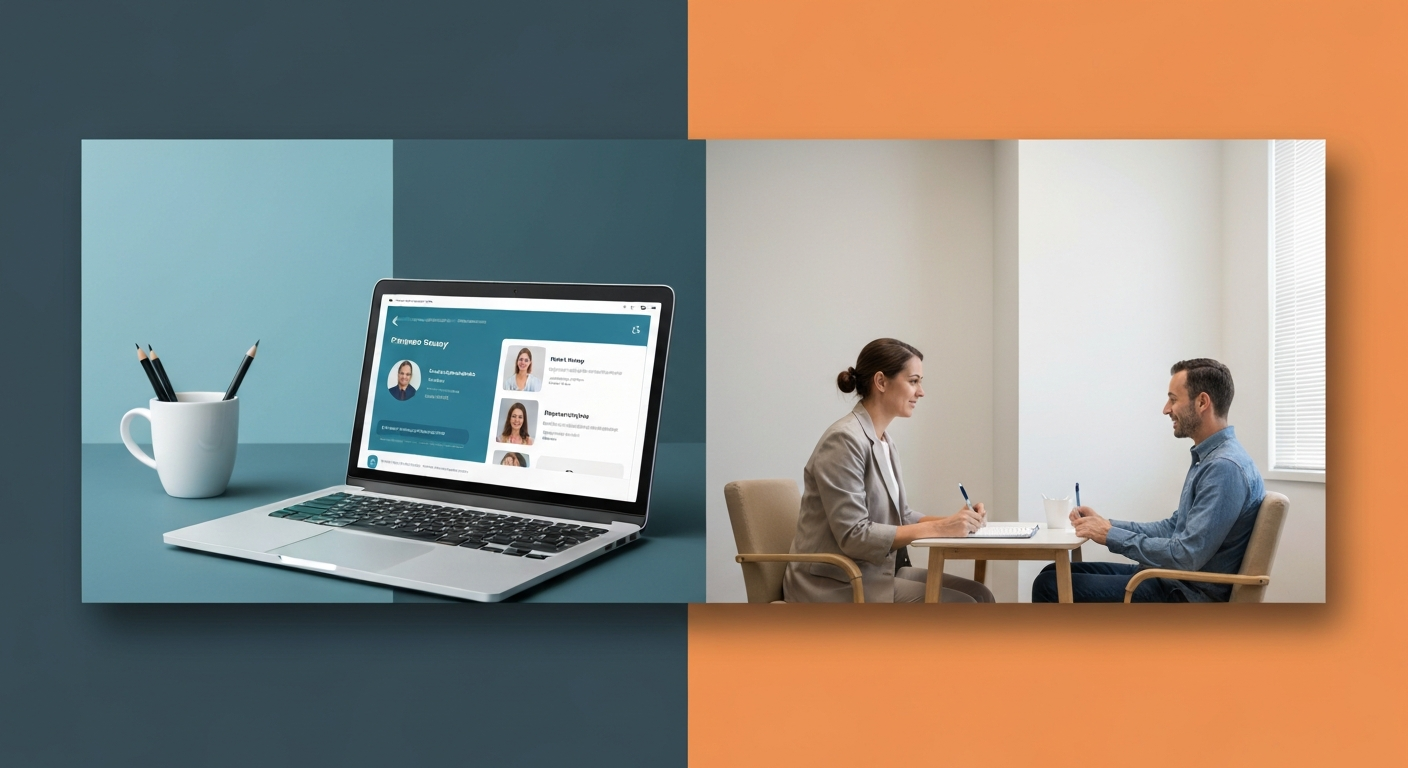
Many Canadians assume the primary difference between online and in-person therapy lies in inherent effectiveness or professional rigour, yet research consistently shows comparable outcomes for many common conditions. The real divergence for a first-timer considering Online vs in-person therapy: a frank cost/benefit for Canadian adults often boils down to subtle but significant personal factors: your comfort with technology, the need for a physically separate therapeutic space, and how you perceive privacy and connection. A 2018-2022 meta-analysis, for instance, found online therapy to be as effective as in-person for anxiety and depression, shifting the focus from 'which is superior?' to 'which aligns better with your life?'
Practically, online therapy typically involves video calls, phone conversations, or even text-based communication, allowing you to connect with a registered psychotherapist from your home in Sudbury or your office in Ottawa. This offers considerable flexibility for someone managing a busy work schedule or childcare responsibilities. In contrast, in-person therapy requires your physical presence at a therapist's office, providing a dedicated, often more traditional, therapeutic environment. For a student living with roommates in downtown Toronto, this dedicated space might offer a crucial sense of privacy and separation.
Regardless of modality, both online and in-person therapy in Ontario can address a wide range of mental health concerns, from managing anxiety and depression to navigating relationship issues. It’s important to know that all regulated mental health professionals in the province—including Registered Psychotherapists, Registered Social Workers, and Psychologists—are qualified to practice both online and in-person. This means your choice isn't about finding a 'better' type of professional, but rather finding the right setting for your initial steps into therapy.
The Cost Factor: Online vs. In-Person Therapy Costs in Ontario
The sticker price of therapy in Ontario often masks the true cost, making the initial search for support feel daunting. While an hourly rate might seem clear, a frank cost/benefit analysis reveals how hidden expenses and insurance nuances can drastically change which option is truly more affordable for your unique situation.
To help you weigh the financial implications, here's a direct comparison of typical costs and considerations for both online and in-person therapy in Ontario:
| Aspect | Online Therapy | In-Person Therapy |
|---|---|---|
| Average Session Fee (Ontario) | Typically $120-$220 per 50-minute session; some platforms like MySerenity offer package deals or slightly lower rates. | Generally $150-$250 per 50-minute session, especially for Registered Psychologists in urban centres like Toronto. |
| Insurance Coverage | Varies significantly. Many private plans cover Registered Social Workers (RSW) and Registered Psychotherapists (RP); always confirm your specific plan's coverage details. | Often covers Registered Psychologists (Psyc.D., Ph.D.) more broadly. Coverage for RSWs or RPs depends entirely on your employer's plan. |
| Hidden Costs & Savings | Eliminates commute costs (gas, transit fares, parking). Reduces time off work. Requires reliable internet and a private space. | Adds significant costs for transportation (e.g., $10-$20 parking in downtown Ottawa), gas, and often requires unpaid time off work for travel. |
| Sliding Scales & Subsidies | Many online platforms and individual practitioners offer income-based sliding scales. Some connect to publicly funded programs. | Available from some private practices and community mental health agencies, though waitlists can be longer for subsidized options. |
When considering online vs in-person therapy, a frank cost/benefit for Canadian adults often shows that while per-session fees might seem similar, the overall financial burden can be significantly different once all factors are included.
"I've seen clients save hundreds a month just by switching to online therapy, not because the session fee was lower, but because they cut out parking, gas, and half an hour of unpaid travel time." — Clinic Administrator, Toronto
Ultimately, the "cheapest" option isn't always the most cost-effective if it means sacrificing consistency or accessibility. Understanding your insurance plan and calculating the true out-of-pocket expense, including hidden costs, is crucial for making a choice that supports both your mental health and your budget.
Accessibility & Convenience: Who Benefits Most from Each Modality?
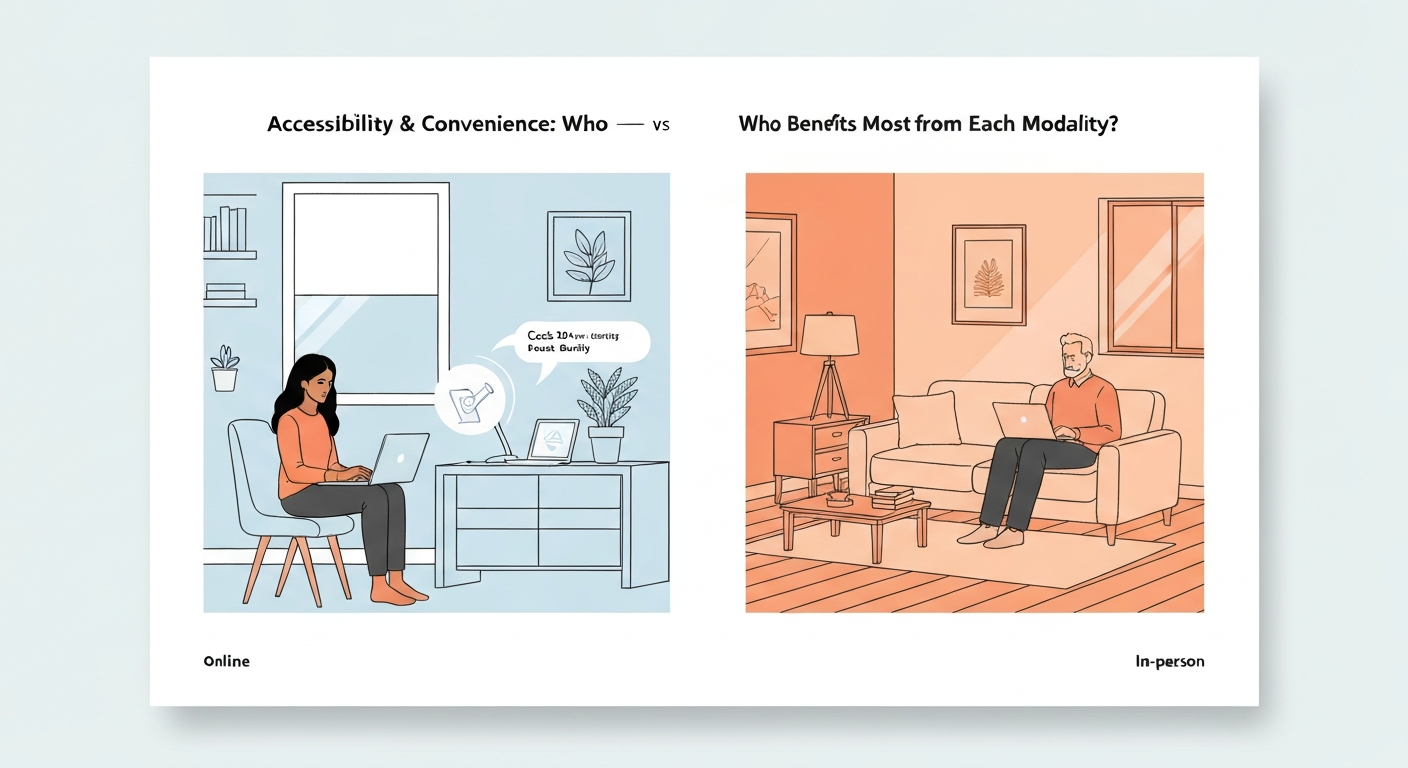
While effectiveness and cost often dominate the discussion around mental health support, for many Canadians, simply accessing therapy is the first, most formidable hurdle. The choice between online and in-person therapy often hinges less on preference and more on the practical realities of your daily life, particularly when considering wait times and geographical barriers across Ontario.
Online Therapy: The Convenience Edge
- Geographic Reach: Virtual counselling Ontario dramatically expands access for those in rural communities like Kenora or underserved areas, or for individuals with limited mobility, overcoming significant physical barriers.
- Scheduling Flexibility: Online platforms often offer broader appointment availability, including evenings and weekends, making it easier to fit sessions into a busy work or family schedule.
- Reduced Wait Times: Some online providers can connect you with a therapist faster than traditional in-person services, addressing a primary concern for the 1 in 3 Canadians facing barriers to care due to long wait times, according to CAMH's 2022 report.
- No Commute Stress: Eliminates travel time, parking hassles, and the stress of navigating traffic in cities like Toronto, saving you both time and money.
- Privacy from Home: Allows you to attend sessions from the comfort and discretion of your own space, a significant benefit for those who prefer anonymity or experience social anxiety.
In-Person Therapy: The Practical Considerations
- Geographic Limitations: Requires you to be physically present at an office, limiting options if you live in a remote area or have limited transportation.
- Fixed Schedules: Typically adheres to standard business hours, which can be challenging to align with a demanding job or childcare responsibilities.
- Potential for Longer Waits: Securing an appointment with a specific in-person therapist, especially specialists in high-demand areas, can sometimes involve longer wait lists.
- Commute Time & Cost: Involves travel time and associated costs (gas, transit, parking), which can add a significant burden to your overall commitment.
- Less Discretion: Attending appointments at a physical office may feel less private for some, especially if you value discretion in your mental health journey.
"I've seen so many clients delay seeking help because they just couldn't physically get to an office during business hours. Online therapy changed that completely for them." — social worker, rural Ontario
The practicalities of accessibility and convenience are often overlooked, yet they can be the deciding factor in whether you even begin your therapeutic journey. Considering these points is a crucial step in assessing whether online vs. in-person therapy offers a frank cost/benefit for Canadian adults like you.
Is Online Therapy as Effective as In-Person Therapy for Anxiety and Other Conditions?
Many Canadians wonder if choosing online therapy means sacrificing effectiveness for convenience. The surprising truth, backed by extensive research over the past decade, is that for common mental health conditions like anxiety and depression, online therapy is often just as effective as traditional in-person sessions. Meta-analyses from 2018-2022 consistently show comparable outcomes for various therapeutic approaches, meaning your choice often comes down to personal fit rather than a significant difference in clinical efficacy.
The core of effective therapy lies in the therapeutic relationship—the connection, trust, and understanding built between you and your therapist. This vital bond can develop powerfully in both modalities. While in-person settings allow for easier observation of subtle non-verbal cues, experienced online therapists adapt, becoming adept at reading tone, facial expressions, and even the pauses in conversation. For some, the physical presence of a therapist in an office fosters a deeper sense of safety, but others find the comfort and anonymity of their own space, perhaps using a platform like MySerenity, more conducive to openness.
"I was skeptical about connecting with someone through a screen, but my online therapist quickly made me feel heard and understood. It wasn't about the room; it was about the conversation and knowing I could talk freely from my kitchen table." — First-time therapy client, Hamilton
Understanding this evidence can alleviate the worry of picking the 'wrong' type of therapy, shifting your focus to what truly supports your personal comfort and needs. The effectiveness of online vs in-person therapy: a frank cost/benefit for Canadian adults ultimately hinges on how well the modality aligns with your individual preferences and circumstances, which is a key part of determining your overall value.
Privacy, Technology, and Environment: Practical Considerations
While cost and convenience often drive the "online versus in-person" therapy discussion, the true differentiator for your experience can often boil down to the less glamorous, everyday practicalities of your chosen setting. It's not just *where* you meet, but *how* that environment supports or detracts from your focus and sense of security that truly matters.Practical Considerations: A Quick Reference
For virtual sessions, therapists use secure, encrypted platforms compliant with Canadian standards like PIPEDA (Personal Information Protection and Electronic Documents Act). However, your role in creating a private physical space at home — free from family interruptions or open windows — is critical. A senior social worker in Calgary recently shared how a client's session was disrupted by a child needing attention, highlighting the need for a clear plan.
The reality of online therapy includes potential internet connectivity issues, software bugs, or device failures. Imagine your session freezing mid-sentence due to a Wi-Fi drop in rural Ontario; these moments, though infrequent, can disrupt flow and emotional processing, requiring patience and perhaps a quick phone call to resume.
A therapist's physical office is meticulously designed for confidentiality and minimal distraction. The soundproofing, comfortable seating, and lack of external interruptions create a controlled, predictable space. This setup often fosters an immediate sense of safety, which can be particularly beneficial for individuals new to therapy or those seeking deep introspection.
Your personal ease with video calls and digital communication significantly impacts your engagement. If you find video calls draining or struggle with eye contact on screen, online therapy might feel less natural. Conversely, if you're fluent with platforms like Zoom or Google Meet, the virtual format might feel like a seamless extension of your daily life.
Both online and in-person therapists have clear plans for emergencies. For online therapy, this includes confirming your physical location and having local emergency contacts readily available, especially when working with clients across different regions of Canada. This ensures that if a crisis arises during a session, appropriate local support can be dispatched quickly.
Making the Right Choice for You: Online vs. In-Person Therapy Decision Framework
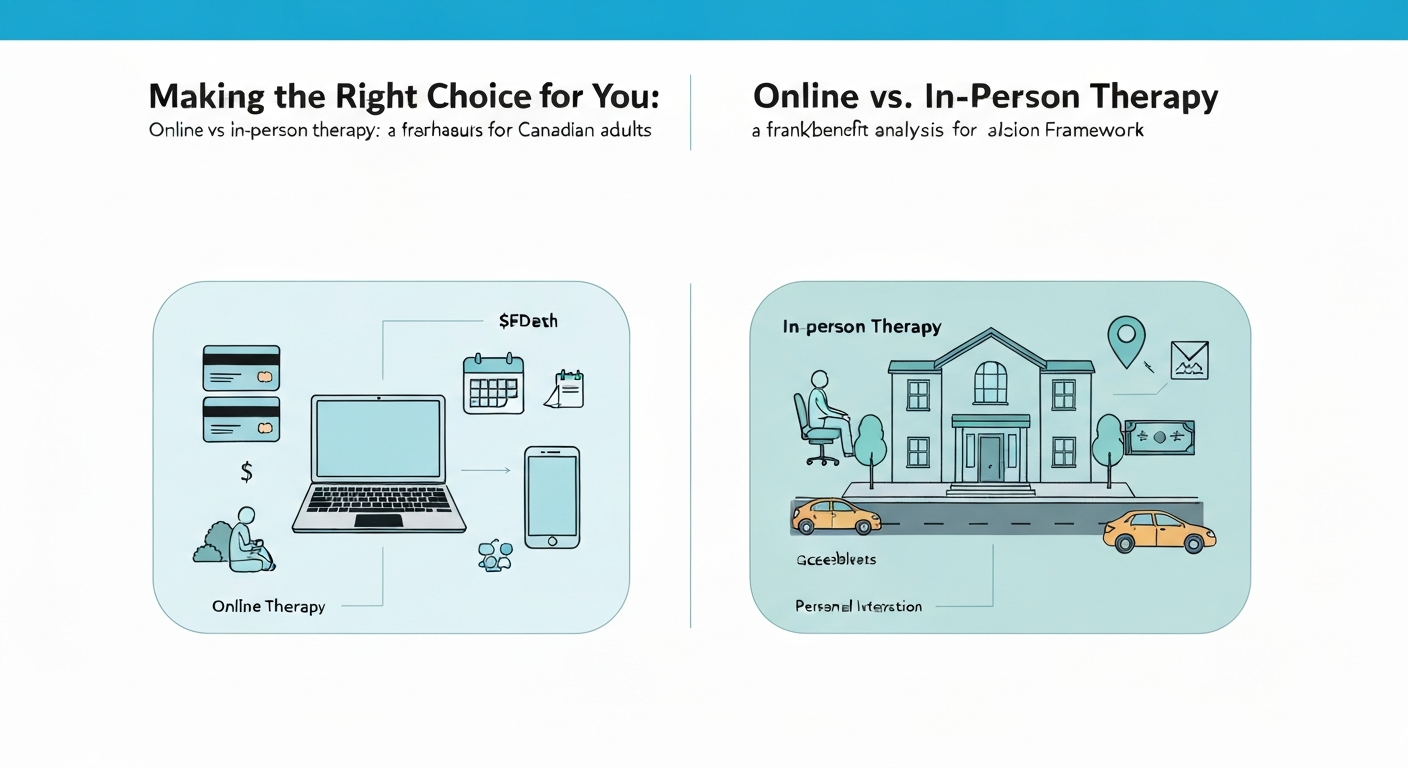
Choosing between online and in-person therapy isn't about finding a universally "better" option; it's about matching the right support to your unique life. Honest self-reflection is key for any Canadian adult seeking support.
Assess Your Budget & Schedule
Ontario therapy sessions cost $120-$250. Factor in travel and parking for in-person in cities like Toronto. Online options often have lower rates or flexible booking, suiting busy schedules or childcare.
Evaluate Your Environment & Comfort
Do you have a private, quiet space at home in Mississauga for online sessions? Or would a neutral office environment feel more conducive? Some prefer a therapist's physical presence; others find online less intimidating.
Consider Specific Needs & Tech Savvy
For severe social anxiety or agoraphobia, online therapy removes barriers. For crisis support or hands-on techniques, in-person might be better. How comfortable are you with video calls and potential tech glitches?
"I initially picked online therapy for convenience, but the constant worry about my internet connection dropping actually made me more anxious. I switched to in-person and felt much more present." — software developer, Toronto
Embrace Flexibility & Trial
This isn't a permanent decision. Start online, like many in rural Ontario for accessibility, then switch if the connection isn't right. Or vice versa. The goal is effective support, not a perfect first choice.
Ultimately, the choice for online vs in-person therapy: a frank cost/benefit for Canadian adults, comes down to your personal circumstances. Use these questions to guide your initial exploration; the most effective therapy is the one you can consistently engage with.
Common Misconceptions About Online and In-Person Therapy
Common Misconceptions About Online and In-Person Therapy
When you first consider therapy, it's easy to get caught up in the perceived differences between talking to someone online versus in person. Yet, many anxieties you might feel about virtual sessions—like doubts about connection or effectiveness—are actually echoes of long-standing concerns about therapy itself, simply amplified by a screen. The core challenge isn't the medium, but overcoming the initial hesitancy to seek support at all.
Sorting through these common misbeliefs is crucial for anyone exploring "Online vs in-person therapy: a frank cost/benefit for Canadian adults." Let's clear the air on some of the most persistent myths, drawing on real data and the experiences of Canadians.
These numbers paint a clearer picture: online therapy isn't a 'lesser' option; it often delivers comparable outcomes for conditions like anxiety and depression, according to meta-analyses from 2018-2022. Moreover, therapy isn't reserved for severe crises; it's a valuable tool for a significant portion of the Canadian population, from managing everyday stress to personal growth. While online options can offer flexibility, the session cost itself often falls within the same broad range as in-person care across Canada.
You might also worry that forming a genuine connection with a therapist is harder virtually. While the experience is different, many individuals in cities like Halifax find strong therapeutic alliances develop just as effectively online.
"I was skeptical about not being in the same room, but my online therapist in Ottawa helped me feel heard and understood from the very first session. It really comes down to the person, not the screen." — first-time therapy client, Ottawa
A skilled therapist adapts to the medium. Finally, there's the misconception that only a 'psychologist' can provide effective care. In Ontario, Registered Psychotherapists and Registered Social Workers are highly qualified, regulated professionals whose services are often more accessible and may be covered by certain insurance plans, similar to psychologists. MySerenity, for instance, connects you with various regulated professionals.
Understanding these realities helps you move past the noise and focus on what truly matters: finding a therapist whose approach resonates with you, regardless of whether your sessions happen in a physical office or over a secure video call.
Next Steps: Finding a Therapist in Ontario (Regardless of Modality)
Deciding between online vs. in-person therapy: a frank cost/benefit for Canadian adults is a significant first step, but the next hurdle—finding the right professional—often feels just as daunting. Many adults in Ontario feel overwhelmed by the sheer number of options and professional titles, even after settling on a modality.
Start your search with reputable directories. Psychology Today is widely used, but for Ontario-specific verification, always check the College of Registered Psychotherapists of Ontario (CRPO) and the Ontario College of Social Workers and Social Service Workers (OCSWSSW) websites. These platforms list qualified professionals and allow you to filter by location, specialty, and whether they offer online or in-person sessions.
Most therapists offer a free 15-20 minute initial consultation. Consider this your chance to interview them. Ask about their therapeutic approach, their experience with concerns similar to yours, and their fees and cancellation policies. Crucially, verify their credentials directly with their regulatory body—for example, confirming a registered psychotherapist with the CRPO—to ensure they are qualified and ethical.
Ultimately, trust your intuition. The 'fit' between you and your therapist is paramount. If something feels off during an initial chat, it's perfectly okay to keep looking. Your goal is a therapeutic relationship where you feel safe, heard, and understood, whether that connection is built virtually or face-to-face.
Frequently Asked Questions
How much does online therapy cost compared to in-person therapy in Ontario?
In Ontario, online therapy sessions typically range from $120-$200 per hour, often slightly less than in-person sessions which can be $150-$250. This difference often stems from reduced overhead for practitioners, who don't need to rent physical office space. While some therapists charge the same regardless of format, you might find more affordable options online, especially if you're seeking a registered psychotherapist or social worker. Costs vary based on the professional's experience and credentials.
Is online therapy as good as in-person for mental health issues?
Research consistently shows that online therapy is as effective as in-person sessions for many common mental health concerns, including anxiety, depression, and PTSD. Studies, like those published in the Journal of Medical Internet Research, indicate comparable outcomes in symptom reduction and client satisfaction. The key is finding a qualified therapist whose approach resonates with you, regardless of the delivery method. Your comfort with the digital format also plays a significant role in its efficacy.
Why choose online therapy over in-person in Canada?
Many Canadians choose online therapy for its unparalleled convenience and accessibility. It removes geographical barriers, allowing you to connect with specialists across provinces or access care from rural areas where in-person options are scarce. You gain flexibility with scheduling, fitting sessions around work or family commitments without travel time. For individuals with mobility challenges, social anxiety, or busy schedules in cities like Vancouver or Montreal, online therapy offers a practical solution.
What are the privacy concerns for online therapy in Canada?
Privacy is a valid concern, but Canadian therapists are bound by strict provincial and federal privacy laws, like PIPEDA and provincial health information acts. They must use secure, encrypted platforms compliant with these regulations, often specifically designed for healthcare. Before starting, ask your therapist about their chosen platform's security measures and data storage practices. Ensure you're in a private space during sessions to protect your confidentiality from your end.
Can online therapy really replace traditional in-person sessions?
For most common mental health challenges, online therapy can effectively replace traditional in-person sessions, offering comparable therapeutic outcomes. However, for severe mental illnesses requiring intensive support, crisis intervention, or specific modalities like play therapy for children, in-person care might be more appropriate. Your therapist will assess if online sessions are suitable for your specific needs. It's about finding the best fit for your unique situation and comfort level.
Frequently Asked Questions
How much does online therapy cost compared to in-person therapy in Ontario?
Is online therapy as good as in-person for mental health issues?
Why choose online therapy over in-person in Canada?
What are the privacy concerns for online therapy in Canada?
Can online therapy really replace traditional in-person sessions?
Keep reading
All articles →
Doctor's Guide: Best AI Mental Wellness Apps for High-Achievers
For high-achievers battling burnout and decision fatigue, the real challenge isn't finding an app, but rather discerning which of the "best AI mental wellness apps" offer personalized, evidence-based support beyond simple meditation. These tools address specific stressors like perfectionism or performance anxiety.
High-Achiever's Blueprint: 7 Evidence-Based Anxiety Coping Strategies
Many high-achievers see anxiety as an unavoidable cost of ambition. However, clinically proven evidence based anxiety coping strategies offer significant symptom reduction, refining your internal operating system for success.

Strategic Mood Tracking: How to Effectively Track Your Mood for Burnout & Anxiety Management
Many find basic mood logging unhelpful for preventing burnout. This guide transforms mood tracking into a strategic process for proactive self-management.