

BetterHelp Alternatives in Canada: Your Ontario Decision Framework
Many Canadians exploring BetterHelp alternatives in Canada prioritize local accountability and cultural understanding. They seek mental health professionals licensed under provincial standards, like those in Ontario, for quality and ethical care.

Why Seek BetterHelp Alternatives in Canada?
Many Canadians exploring BetterHelp alternatives in Canada: what to know before signing up often prioritize local accountability and cultural understanding over sheer platform availability. While global online therapy platforms offer convenience, a significant driver for Canadians is the desire for mental health professionals licensed and regulated under specific provincial standards, like those set by the College of Psychologists of Ontario, ensuring a familiar framework for quality and ethics.
Past controversies surrounding data privacy and ethical practices on some large international platforms have made many individuals cautious. This concern fuels a search for transparent services that explicitly adhere to Canadian privacy laws, such as PIPEDA, and provincial health information acts. You want to feel secure that your personal health information is handled with the highest standard of care.
"Knowing my therapist understands the nuances of the Canadian healthcare system and our cultural context makes a huge difference. It's not just about language; it's about shared understanding." — client
Beyond privacy, Canada's healthcare system plays a major role. You might be seeking a service that understands provincial regulations, public health supports, and, crucially, how services are covered by Canadian insurance plans. Many private plans require specific professional designations, like a Registered Psychologist or a Registered Social Worker, for reimbursement. About 1 in 5 Canadians experience a mental health problem in any given year, according to CMHA National, underscoring the need for accessible, locally relevant support.
This pursuit for Canadian-centric options ultimately aims to reduce 'wrong fit' anxiety, ensuring your investment in mental wellness aligns with local standards, cultural insights, and financial realities, setting the stage for a more effective therapeutic relationship.
Therapist vs. Counsellor vs. Coach: Understanding Professionals in Ontario
Many Canadians feel overwhelmed when trying to find mental health support, often unsure whether they need a therapist, a counsellor, or a coach. This confusion is particularly common in Ontario, where different professionals operate under distinct regulatory frameworks, impacting both the type of help you receive and whether your private insurance will cover it.
"Understanding the difference between a psychotherapist and a coach isn't just semantics; it directly impacts the kind of support you'll get and if your benefits will pay for it." — Employee Benefits Administrator, Toronto
Understanding these roles is key when exploring BetterHelp alternatives in Canada:
| Professional Type | Primary Focus | Ontario Regulation/Credential | Insurance Coverage Notes |
|---|---|---|---|
| Psychotherapist/Therapist | Diagnoses and treats mental health conditions (e.g., depression, anxiety, trauma). | Regulated by CRPO. Psychologists (CPO), Social Workers (OCSWSSW). | Often covered if registered with a college. Verify your plan. |
| Counsellor | Addresses life challenges, emotional support, personal growth, coping strategies. | May be CRPO regulated or by associations like CCPA. | Varies. Often requires CRPO registration or specific designations (e.g., RSW). |
| Coach | Goal setting, skill development, performance, future-oriented action. Not diagnosis. | Generally unregulated in Ontario. No regulatory college. | Rarely covered; do not diagnose or treat mental health conditions. |
Your choice hinges on your needs. If you suspect a mental health condition or need clinical treatment, a regulated psychotherapist, psychologist, or social worker is best. For life transitions or personal development without diagnosis, a counsellor or coach might be a fit. Private health insurance in Canada often dictates coverage by professional designation.
Online vs. In-Person Therapy: Which is Right for Canadians?
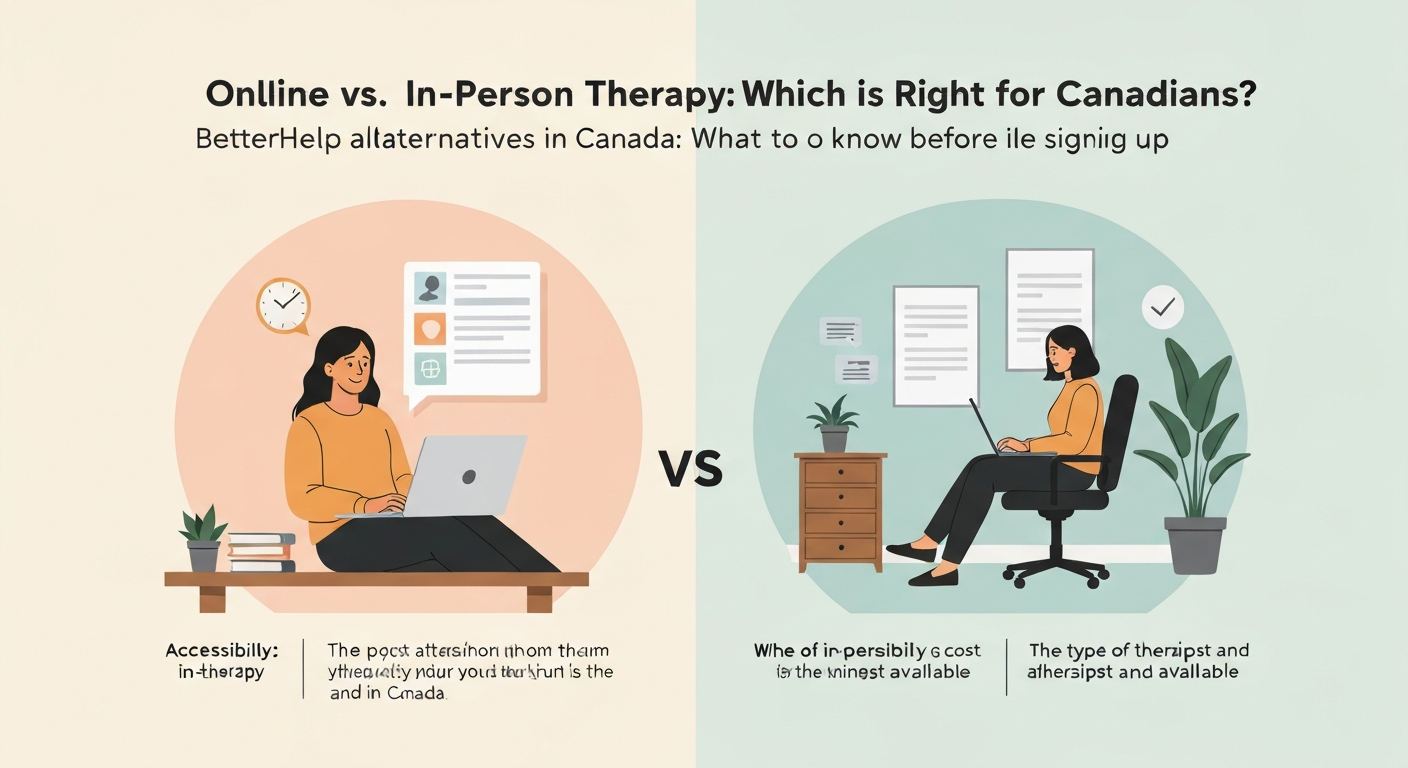
While convenience often drives the online versus in-person therapy decision, the real question for many Canadians isn't just about logistics, but about the depth and type of connection they need to feel truly supported. Your comfort with technology and the complexity of your current challenges significantly shape which model will serve you best in Ontario.
Online Therapy Advantages
- Offers improved accessibility for individuals in remote areas, like many communities across Northern Ontario.
- Potentially shorter wait times for initial appointments with some specialists on platforms like MySerenity.
- Provides a wider selection of licensed professionals across the entire province, not just your local area.
- Eliminates travel time and associated costs, making sessions easier to fit into a busy schedule.
Online Therapy Considerations
- Potential for technological issues like buffering video calls or dropped connections can disrupt sessions.
- Some individuals may find it harder to establish a deep, personal connection through a screen.
- Privacy concerns exist with platforms that don't explicitly detail their data handling and encryption practices.
- May not be suitable for severe or complex mental health conditions requiring immediate, in-person support.
In-Person Therapy Advantages
- Provides direct human connection, allowing for easier reading of subtle non-verbal cues and body language.
- Often preferred for complex issues, where the shared physical space can help foster a strong therapeutic bond.
- Offers a dedicated, distraction-free environment specifically designed for therapeutic work.
- Can feel more traditional and grounding for those who prefer a structured, face-to-face approach.
In-Person Therapy Considerations
- Geographic limitations mean fewer options in smaller towns or rural areas compared to major cities like Toronto.
- Potentially longer wait times for specific therapists in high-demand urban centres, such as for child psychologists in Ottawa.
- Requires travel, adding commute time and transportation costs to each session.
- Offers less scheduling flexibility, as appointments are tied to a physical location and therapist's office hours.
"Online sessions can bridge distances and make therapy accessible, but sometimes, sharing that physical space with someone across a room makes all the difference for a client to truly open up." — Registered Social Worker, Toronto
Some individuals find a hybrid approach ideal, combining the flexibility of online check-ins with occasional in-person sessions for deeper work or specific modalities. Understanding these distinctions is crucial when exploring BetterHelp alternatives in Canada: what to know before signing up, as your choice significantly impacts the effectiveness and comfort of your mental health support journey.
Top BetterHelp Alternatives in Canada: Ontario-Focused Platforms & Services
Many Ontarians feel overwhelmed by the sheer number of online mental health options, often making the search for BetterHelp alternatives in Canada: what to know before signing up feel like another stressor. The real challenge isn't a lack of services, but discerning which platforms genuinely align with Canadian regulations, professional standards, and your specific needs within Ontario. This section cuts through the noise, highlighting reputable online platforms and services designed with Canadian users in mind.
When considering online therapy platforms accessible in Ontario, it's helpful to compare their structure, professional offerings, and commitment to Canadian data privacy.
| Platform / Resource | Primary Focus | Ontario Access | Key Feature / Benefit | Data Privacy & Compliance |
|---|---|---|---|---|
| Inkblot Therapy | Online therapy & counselling | Yes, Canadian-licensed professionals | Personalized therapist matching, sliding scale fees available | Canadian servers, PHIPA compliant |
| Maple | Telemedicine (includes mental health) | Yes, medical & mental health professionals | Integrated virtual care, often covered by employer benefits | Canadian servers, PHIPA compliant |
| Psychology Today Canada | Directory of private practitioners | Yes, extensive Ontario listings | Direct connection to individual therapists, detailed profiles | Practitioner-specific; platform generally secure |
| CMHA Ontario | Provincial mental health resources & support | Yes, various programs & information | Publicly funded programs, community connections, crisis lines | Governed by provincial health privacy laws |
| MySerenity | Digital mental wellness app | Yes, app-based support & tools | CBT-based exercises, mood tracking, guided meditations | Canadian servers, privacy policy available |
Each of these options presents a distinct approach to mental wellness, making it crucial to consider your personal preferences for professional matching, service integration, and data handling.
Beyond these platforms, remember that Ontario's publicly funded digital mental health services, often found through local health networks like the Ontario Health Teams, offer valuable support without direct cost. For those seeking a specific professional, directories like the College of Registered Psychotherapists of Ontario (CRPO) or provincial social work registries provide direct links to individual, regulated practitioners right in your community. Exploring these options helps you find support that respects both your well-being and Canadian standards.
BetterHelp Alternatives Canada Cost: Navigating Affordability & Insurance in Ontario
The cost of therapy often creates a barrier to seeking support, causing significant stress. Understanding Ontario's financial landscape, including insurance coverage and affordable options, is crucial for accessing the mental health care you need.Cost & Coverage in Ontario
In 2024, a private therapy session in Ontario typically costs $120 to $250 per hour. Rates vary by professional designation; a Registered Psychologist, for instance, usually charges more than a Registered Social Worker.
Many Canadian private health plans offer limited mental health coverage. Reimbursement often requires specific designations, such as a Registered Psychologist (RP) or Registered Social Worker (RSW). Check if a Certified Canadian Counsellor (CCC) is also covered.
Thoroughly review your employer's Extended Health Benefits (EHB) for annual maximums, eligible professional types, and any co-pay requirements. A call to your provider (e.g., Manulife, Sun Life) can clarify specifics.
Explore practices with sliding scale fees based on income, or consider student therapists supervised by licensed professionals at university clinics. Group therapy is also a valuable, cost-effective option, significantly cheaper than individual sessions.
When evaluating BetterHelp alternatives in Canada, what to know before signing up includes clear pricing. Ensure any professional or platform provides transparent fee structures and detailed invoices for easy insurance claims.
How to Vet a Mental Health Professional or Platform: Your Canadian Checklist
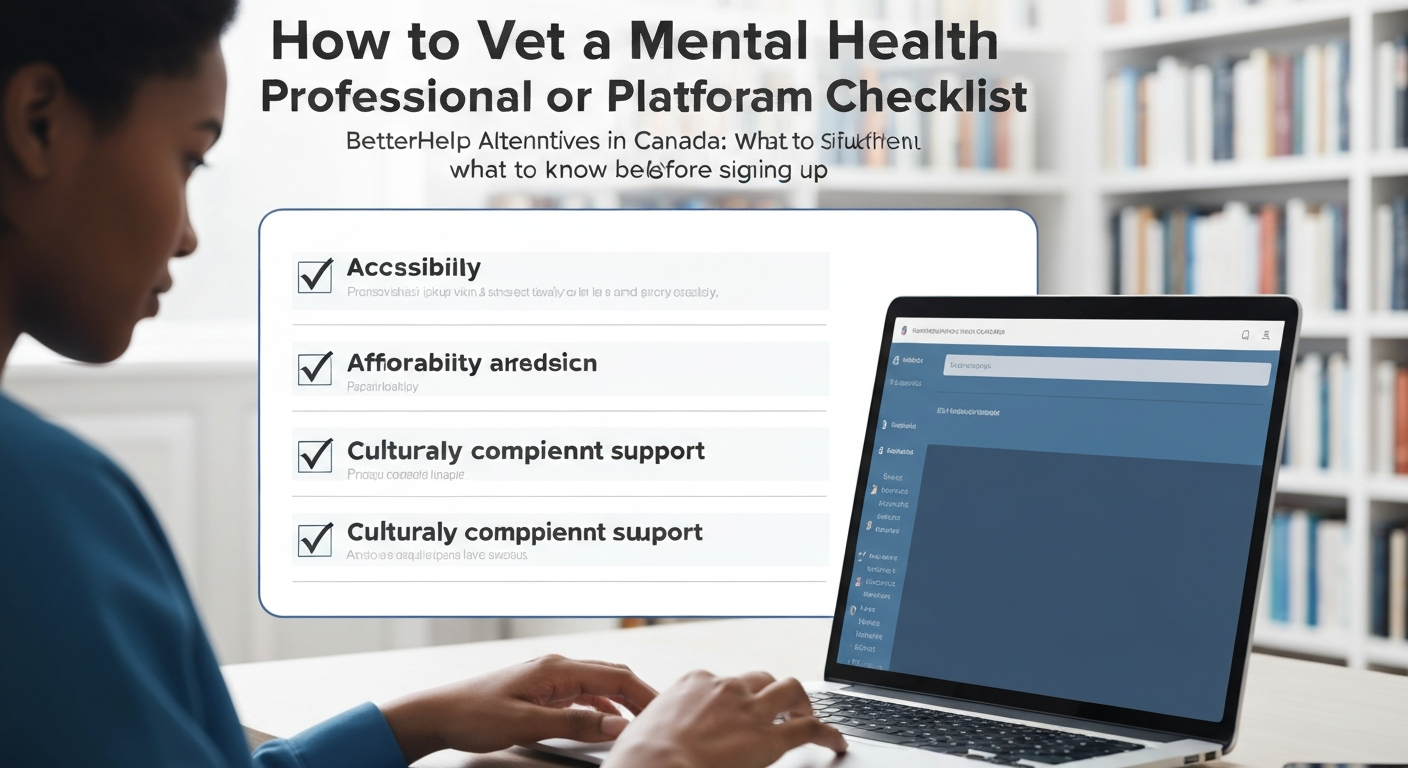
Verify Credentials & Regulation
In Ontario, ensure your professional is registered with a provincial college like CRPO, CPO, or OCSWSSW. This confirms ethical and competency standards.
Understand Their Therapeutic Approach
Ask about primary modalities (e.g., CBT, DBT, EFT). This ensures their methods align with your preferences and specific issues.
Inquire About Data Privacy & Security
For online platforms, confirm how your health information is protected. Ask about encryption, storage, and compliance with Canadian laws like Ontario's PHIPA.
Discuss Fees & Insurance
Clarify per-session costs, payment methods, and if they provide detailed receipts. These are crucial for submitting claims to your private health insurance provider.
Assess Fit & Comfort
Use initial consultations to gauge rapport. You need to feel heard, respected, and comfortable with their style.
"Finding someone who truly 'gets' you from the first conversation makes all the difference; it sets the tone for genuine progress." — client advocate, Toronto
Know Your Recourse
Understand the professional's or platform's policy if the fit isn't right or if concerns arise. A clear process shows commitment to client well-being.
Addressing Wait Times: Strategies for Faster Access to Mental Health Support in Ontario
The irony of knowing you need mental health support, yet facing an unbridgeable chasm to actually receive it, is a common source of frustration for many in Ontario. It's not just about finding the 'right' therapist; it's often about navigating a system where even excellent resources have significant waitlists. This challenge is stark: only about one-third of Canadians who report needing mental health services actually receive them, according to CMHA National.
While publicly funded services can be invaluable, their wait times often lead individuals to explore private options. Proactively strategizing your search can significantly reduce the time between seeking help and getting it. Online therapy platforms, often considered BetterHelp alternatives in Canada: what to know before signing up, present a viable path with shorter intake processes and broader availability compared to traditional in-person practices.
Understanding these immediate access points is the first step towards getting the support you deserve. Once you've explored these avenues, the next critical step involves understanding the types of professionals available and how to choose the right fit for your specific needs.
Beyond Online Platforms: Community & Low-Cost Mental Health Resources in Ontario
Beyond the array of online therapy platforms, Ontario offers a rich ecosystem of community-based and publicly funded mental health resources that can provide vital support, often at no direct cost. These options are often overlooked when you're searching for BetterHelp alternatives in Canada: what to know before signing up, despite their significant value.
The Canadian Mental Health Association (CMHA) Ontario, for instance, provides a lifeline for many. With local branches across the province, CMHA offers diverse programs, support groups, and crucial information on local services. Roughly 1 in 5 Canadians will experience a mental health problem or illness in any given year, according to CMHA National, highlighting the widespread need for accessible support.
Many Family Health Teams (FHTs) and Community Health Centres (CHCs) in Ontario integrate mental health services directly into their primary care. This means you might find social workers, counsellors, and other mental health professionals within your local FHT or CHC, with services often covered by OHIP. This can significantly reduce financial barriers to care for residents in places like Kingston or Thunder Bay.
Peer support networks also offer a unique form of connection, pairing individuals with shared lived experiences. These groups foster understanding and provide practical coping strategies in a supportive environment. Similarly, religious and cultural organizations across Ontario frequently provide culturally sensitive counselling and support services, tailored to specific community beliefs and needs, which can be particularly comforting and effective for newcomers or specific cultural groups.
Finally, provincial government initiatives in Ontario also fund various mental health and addiction services. While these may have specific eligibility criteria and wait times can vary, they represent a low-cost or free pathway to professional care. Exploring these local, community-driven options ensures you consider a full spectrum of support beyond commercial platforms, empowering you to build a comprehensive wellness strategy.
Frequently Asked Questions
Why should I consider BetterHelp alternatives in Canada?
You might seek BetterHelp alternatives due to concerns about therapist licensing and regulation, which varies significantly across Canadian provinces. Platforms like BetterHelp often use US-based therapists, raising questions about their registration with bodies like the College of Psychologists of Ontario or the BC College of Social Workers. Additionally, Canadian data privacy laws, such as PIPEDA, might not fully apply to US-based companies. Exploring Canadian-specific options ensures your therapist understands local healthcare systems and cultural nuances, potentially offering more relevant support.
What are some affordable online therapy options in Ontario besides BetterHelp?
In Ontario, several affordable online therapy options exist. The Ontario Structured Psychotherapy (OSP) program offers free, evidence-based cognitive behavioural therapy (CBT) for mild to moderate anxiety and depression, accessible through local providers. Many university psychology clinics, like those at the University of Toronto or Western University, provide lower-cost services delivered by supervised graduate students. Additionally, some Canadian platforms, such as Inkblot Therapy or Well.ca, offer sliding scale fees or package deals, making mental health support more accessible than traditional private practice.
How can I vet a mental health professional or platform in Canada?
To vet a mental health professional or platform in Canada, first confirm their provincial licensing. For example, in Alberta, check the College of Alberta Psychologists; in Quebec, the Ordre des psychologues du Québec. Ensure the platform clearly states its data privacy practices, ideally compliant with Canadian privacy laws like PHIPA in Ontario. Look for transparent fee structures and cancellation policies. A reputable platform will offer a free initial consultation, allowing you to assess therapist fit and ask about their experience with your specific concerns before committing.
Is there a difference between a therapist and a counsellor in Ontario?
In Ontario, "therapist" is a broad term, but specific titles like "Psychologist," "Psychotherapist," "Social Worker," and "Occupational Therapist" are regulated. This means professionals using these titles must be registered with their respective colleges, such as the College of Registered Psychotherapists of Ontario (CRPO) or the Ontario College of Social Workers and Social Service Workers (OCSWSSW). The term "counsellor" is not regulated, meaning anyone can use it without specific training or oversight. Always verify a practitioner's registration with their professional college to ensure accountability and ethical standards.
What are strategies to reduce wait times for mental health support in Ontario?
To reduce wait times for mental health support in Ontario, start by discussing your needs with your family doctor; they can often provide referrals to provincially funded programs or specialists. Explore community mental health agencies, many of which offer immediate crisis support or short-term counselling without long waits. Consider employee assistance programs (EAPs) if available through your workplace, as these often provide quick access to counselling. For more immediate, albeit private, options, online platforms like MySerenity or Inkblot can connect you with therapists within days, though costs apply.
Frequently Asked Questions
Why should I consider BetterHelp alternatives in Canada?
What are some affordable online therapy options in Ontario besides BetterHelp?
How can I vet a mental health professional or platform in Canada?
Is there a difference between a therapist and a counsellor in Ontario?
What are strategies to reduce wait times for mental health support in Ontario?
Keep reading
All articles →
Doctor's Guide: Best AI Mental Wellness Apps for High-Achievers
For high-achievers battling burnout and decision fatigue, the real challenge isn't finding an app, but rather discerning which of the "best AI mental wellness apps" offer personalized, evidence-based support beyond simple meditation. These tools address specific stressors like perfectionism or performance anxiety.

High-Achiever's Blueprint: 7 Evidence-Based Anxiety Coping Strategies
Many high-achievers see anxiety as an unavoidable cost of ambition. However, clinically proven evidence based anxiety coping strategies offer significant symptom reduction, refining your internal operating system for success.

Strategic Mood Tracking: How to Effectively Track Your Mood for Burnout & Anxiety Management
Many find basic mood logging unhelpful for preventing burnout. This guide transforms mood tracking into a strategic process for proactive self-management.